
Affiliate marketing for dancers is one of the simplest ways to start earning from your audience in India without waiting for big sponsorship deals—but it only works if you understand how links, commissions, and disclosure rules actually operate in 2026.
1. What Is Affiliate Marketing for Dancers and Creators?
Affiliate marketing is a performance-based system where a business rewards you (the affiliate) when your audience buys something or takes a defined action through your special trackable link. [1][2]
Instead of being paid upfront to post about a brand, you earn a commission only when your followers actually purchase or sign up. Shopify describes it as a model where creators promote products to their audience and get a share of the revenue when sales are tracked back to them. [1]
For dancers, that could mean:
- Linking to the ghungroos or costumes you wear in your Odissi videos.
- Sharing your favourite ring light or tripod used to film reels.
- Recommending an online choreography course you personally found helpful.
You do not need your own product or a formal brand deal to get started. Many affiliate programs accept small or mid-sized creators, as long as you can create original content and have some relevant audience. [4][5]
2. Affiliate Marketing vs Sponsorships: What’s the Difference?
Both affiliate marketing and sponsorships are commercial relationships, so both require clear disclosure under Indian advertising guidelines. [8][10] But the money and control work differently.
| Aspect | Affiliate Marketing | Sponsorship / Brand Deal |
|---|---|---|
| How you’re paid | Commission on sales or actions tracked via your link | Fixed fee (or package rate) for agreed content |
| Upfront guarantee | Usually none; earnings depend on performance | Yes; amount is agreed before posting |
| Who decides content | Mostly you; brand sets program rules but doesn’t brief every post | Brand usually gives a detailed brief and approval rights |
| Risk level | Your income fluctuates with sales and returns | Income more stable per deal, but fewer opportunities |
| Typical for smaller creators? | Yes, easier entry; many programs accept niche creators | Harder; brands often prefer large reach |
In short, sponsorships pay for your content, while affiliate marketing pays for results. Both must be clearly labeled as advertising or affiliate content under ASCI’s influencer guidelines. [8][10]
3. How Affiliate Marketing Works: Links, Cookies, and Commissions
Affiliate systems rely on fairly standard technology. Understanding it will help you avoid unrealistic expectations.
3.1 Your unique affiliate link
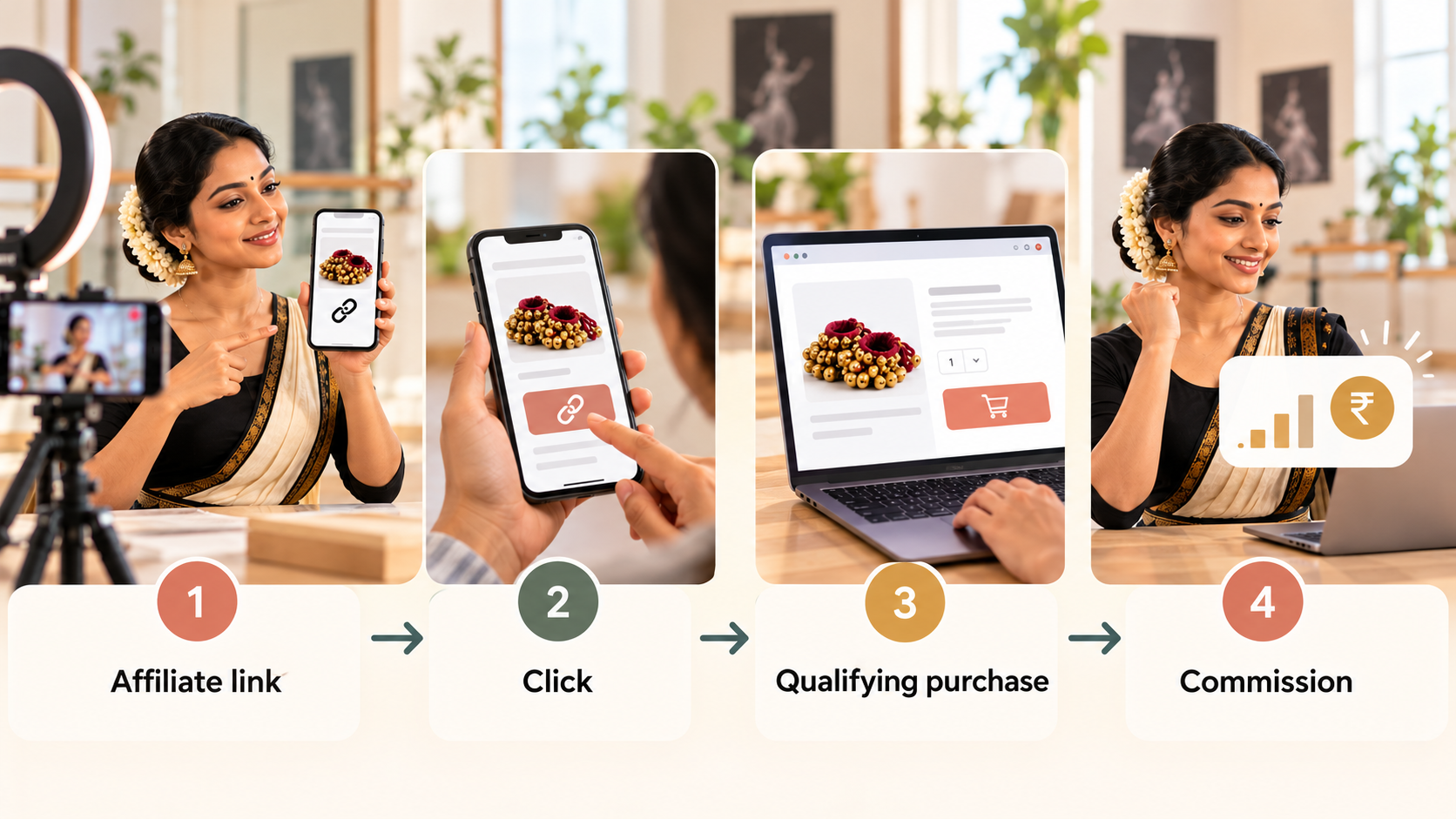
When you join an affiliate program, you get unique URLs or discount codes that identify you as the referrer. When someone clicks that link, the program can attribute any resulting purchase or signup to you. [1][2]
Typical behaviour:
- Viewer taps your link in a reel, YouTube description, or blog.
- They land on the product page or sign-up page.
- The merchant’s system records that this visitor came from your link.
3.2 Cookies and attribution windows
Most programs use browser cookies or similar technology to track when a visitor later completes a purchase. [3]
Key points:
- Cookie or attribution window: The time period during which a sale can still be credited to you after the click. Common windows range from 24 hours to 30–90 days, but each program sets its own rules in the terms and conditions.
- Attribution model: Many programs use “last-click” attribution, where the last affiliate link clicked gets the commission if multiple creators promoted the same product.
Always read the program’s current terms to know:
- How long your cookie window is.
- Whether there are restrictions (for example, sales from your own account may not qualify).
3.3 Commission structures
Commission models vary widely. According to Shopify, affiliates may be paid as a percentage of the sale value or a flat amount per signup or subscription, and rates differ by niche. [1][4][5]
You’ll typically see:
- Percentage of sale – common for products like clothing, gear, or accessories.
- Fixed fee per action – common for software tools, subscriptions, and some online courses.
Because commissions and rules differ by merchant, comparing multiple programs is essential before you invest time creating content.
3.4 Payouts and minimum thresholds
Most affiliate programs:
- Set a minimum payout threshold you must reach (for example, a certain amount of commission) before they send money.
- Pay on a schedule such as monthly or on a net‑30 or net‑60 basis, as described in their terms.
For example, the Shopify Affiliate Program pays commissions when referred users sign up for qualifying paid plans and meet certain conditions defined in the program’s official rules. [5] Other programs have similar “qualified sale” requirements.
Always check:
- Minimum payout amount.
- Supported payout methods for Indian residents (bank transfer, international wallet, etc.).
- Whether there are additional verification steps.
4. Can Indian Dancers Really Earn Without Sponsorships?
Nothing in affiliate marketing requires you to have a sponsor or a huge audience. Shopify’s beginner guides emphasise that creators can start by recommending products to niche audiences via organic content—blogs, YouTube, social media—without investing money upfront. [1][4]
In practice, Indian dancers and dance instructors can earn if:
- You join affiliate programs that accept participants from India.
- Your audience is engaged and actually buys using your links.
- You follow ASCI’s influencer advertising guidelines and the program’s terms.
However:
- Earnings are not guaranteed and often start small.
- Affiliate marketing typically works best as an additional income stream, not your only source.
Illustrative earnings example (not a promise)
Assume you promote a pair of practice dance shoes through an affiliate program that pays a 10% commission.
- Product price: ₹2,000 (illustrative)
- Commission rate: 10%
- People who click your link in a month: 100
- People who actually buy (5% conversion, for example): 5
Your illustrative commission:
- 5 buyers × ₹2,000 × 10% = ₹1,000
This is only an example; real conversion rates and commissions can be higher or lower. Programs may also reverse commissions if orders are cancelled or refunded—check the terms for each program.
5. Choosing the Right Dance-Related Products to Promote
According to Shopify, successful affiliates choose products aligned with their expertise and their audience’s needs. [1][4] For dancers, that typically means practical items you already use.
Possible categories (examples only):
- Dancewear and costumes
- Practice sarees, tights, skirts, practice kurtas.
- Performance costumes for Odissi, Bharatanatyam, Kathak, or fusion pieces.
- Footwear and accessories
- Ghungroos or ankle bells (where culturally and technically appropriate).
- Ballet or jazz shoes, sneakers for choreography.
- Hair accessories, pins, tapes, costume jewellery.
- Filming and audio gear
- Tripods and phone mounts for recording full‑body shots.
- Ring lights or softboxes for indoor shoots.
- Microphones for class recordings or YouTube tutorials.
- Online courses and tools
- Dance technique or choreography courses.
- Music editing software, rhythm training apps, or creator-business courses.
- Fitness and recovery aids
- Yoga mats, resistance bands, foam rollers—explained specifically in the context of dance training.
Guiding principles:
- Prioritise products you genuinely use and can describe honestly.
- Avoid low‑quality or irrelevant products; Shopify notes that audience trust is critical for affiliate success. [1]
6. How to Find and Evaluate Affiliate Programs in India
Shopify recommends that beginners look at both individual brand programs and broader affiliate networks. [1][4] For Indian dancers, a structured approach helps.
6.1 Where to look
- Search by product or brand
- Try queries like “brand name affiliate program” or “dancewear affiliate program”.
- Check tools and platforms you already use
- Many software tools and course platforms have “Partners” or “Affiliates” sections in the footer.
- Explore affiliate networks cautiously
- There are networks that bring many merchants into one dashboard. Before joining any, check whether they:
- Accept publishers residing in India.
- Offer payout methods that work for you.
Because eligibility and payout options can change, always rely on the current official terms instead of third‑party lists.
6.2 How to evaluate a program
Based on general affiliate guidance, including Shopify’s resources, compare programs on: [1][4]
- Commission rate and type
- Percentage vs flat fee; one‑time vs recurring.
- Cookie/attribution window
- Longer windows can capture more delayed purchases; check the exact duration in the terms. [3]
- Payout methods and minimums
- Confirm if they can pay to Indian accounts or compliant wallets.
- Brand trust and product quality
- Will you feel comfortable putting your name behind these products?
- Program rules
- Some programs have strict policies on where you can share links or how you can advertise.
If any part of the program terms seems unclear, look for contact details or help documentation before committing serious effort.
7. Step-by-Step: Getting Started With Affiliate Marketing for Dancers
Drawing on beginner-friendly workflows suggested by Shopify, here is a practical path to start with minimal cost. [1][4]
Step 1: Define your dance niche and audience
Clarify who you speak to most often:
- Odia folk and classical dance learners?
- Urban choreography fans on Instagram Reels?
- Parents of kids in beginner Bharatanatyam classes?
The clearer your niche, the easier it is to select relevant products and keywords.
Step 2: Audit your existing platforms
List where you already have reach:
- Instagram (reels and stories)
- YouTube (long videos and Shorts)
- Facebook or WhatsApp groups for your students
- A blog or simple website, if any
Affiliate marketing can work on any of these, as long as you can share clickable links and add clear disclosures.
Step 3: Shortlist products you already use
Take inventory of tools and items you naturally mention:
- The ghungroos or practice outfits you wear weekly.
- The tripod that fits in your dance bag.
- The course that helped you learn editing or choreography.
Search whether these brands or platforms have affiliate programs. If they do, read their terms and apply.
Step 4: Apply to 2–5 well-matched programs
Start small so you can learn how tracking and payouts work.
When applying, you may need to provide:
- Links to your channels.
- A short explanation of your content and audience.
- Tax or identity information if required by the program’s compliance rules.
Some programs accept you instantly; others review manually.
Step 5: Plan content around genuine recommendations
Using formats recommended in affiliate playbooks and Shopify’s content guides, build content that naturally integrates products. [1]
Examples for dance creators:
- “What’s in my dance bag?” – costumes, shoes, safety accessories, with links.
- Studio or home setup tour – lights, tripods, backgrounds, microphones.
- Costume care tutorial – storage bags, garment steamers.
- Follow-along class – mention and link to the exact shoes or props you use.
Make the content useful on its own. The affiliate link should feel like a resource, not pressure.
Step 6: Place links and calls-to-action (CTAs) clearly
Depending on platform:
- Instagram – Use link in bio, story link stickers, and possibly guides or pinned posts.
- YouTube – Put main affiliate links in the top few lines of the description; mention them in the video.
- Blog/website – Add contextual text links, buttons, and a short resources section.
Explain briefly what happens when they use the link, e.g., “If you buy through this affiliate link, I may earn a commission at no extra cost to you.” This style of explanation is aligned with international best practice and supports transparency. [1][8]
Step 7: Add proper affiliate disclosures
Under ASCI’s influencer guidelines, any material connection—including affiliate relationships—must be clearly disclosed using appropriate labels like “Ad”, “Sponsored”, or “Affiliate”. [8][10]
For Indian dance creators, this usually means:
- Including a clear disclosure label (such as “#ad” or “#affiliate”) near the beginning of captions.
- Displaying a visible label on-screen in videos, not only in the description, for at least the minimum time suggested in ASCI’s social media guidance. [9][10]
- Using language your audience understands (English or the language of the content).
Do not hide disclosures among dozens of hashtags or at the very end of long descriptions.
Step 8: Monitor analytics and refine
Once links are live:
- Check affiliate dashboards for clicks, conversions, and commissions. [1]
- Use platform analytics (YouTube Studio, Instagram Insights) to see which posts drive the most profile visits and link taps.
Double down on the formats and topics that both perform well and feel authentic to your style of teaching or performing.
8. Practical Example: Promoting a Dance Product With an Affiliate Link
Consider a hypothetical creator, “Ananya”, who teaches Odia dance online.
- Identifying a product
- She uses a particular type of ankle bells and a ring light in nearly every tutorial.
- Joining an affiliate program
- She learns that an online retailer offers an affiliate program for dance accessories.
- She applies through their official site, shares her YouTube channel link, and is approved.
- Planning content
- She creates a video: “How I Set Up My Room to Record Odia Dance Tutorials”.
- She demonstrates camera placement, lighting, and audio.
- Adding links and disclosures
- In the YouTube description, the first lines say:
- “Affiliate links below – I may earn a commission if you purchase, at no extra cost to you.”
- Underneath, she adds:
- “Ring light I use (affiliate): [link]”
- “Ankle bells similar to mine (affiliate): [link]”
- In the video itself, a small label reading “Affiliate promotion” appears while she showcases the items, consistent with ASCI guidelines on clear, superimposed labels. [8][10]
- Tracking results
- Over the next month, she checks her affiliate dashboard to see how many clicks and purchases came from that video.
- She notices more conversions after adding a brief spoken call‑to‑action: “Links are in the description if you’d like to see the exact equipment I use.”
This workflow combines authentic teaching content with transparent affiliate promotion, rather than turning the channel into pure advertising.
9. How Commissions, Returns and Payout Eligibility Work
Even if someone clicks your link, several conditions must be met before you receive money.
9.1 Qualified sales and actions
Programs usually pay only for “qualified” sales or actions, which may exclude:
- Orders you place for yourself.
- Orders cancelled or refunded by the buyer.
- Sales where the payment fails or is flagged as fraud.
For instance, Shopify pays affiliates for referred merchants who sign up and become paying customers on eligible plans, according to its program rules. [5]
9.2 Reversals and chargebacks
Many affiliate terms state that if a customer returns a product or cancels a subscription within a specified period, your commission can be reversed.
Implications:
- Avoid encouraging impulsive or misleading purchases.
- Choose reliable products with low return rates when possible.
9.3 Hitting payout thresholds
You only get paid when you cross the minimum threshold and the program arranges a scheduled payout (often monthly or net‑30/60). [1]
If your earnings are irregular:
- Expect that it may take several months before your first payout.
- Track your balances and payout dates in a simple spreadsheet.
10. Affiliate Disclosure Rules and Audience Trust in India
The Advertising Standards Council of India (ASCI) is the country’s self-regulatory body for advertising. [7] Its guidelines for influencer advertising apply to affiliate marketing as well. [8][9]
10.1 What ASCI requires
Key points from ASCI’s influencer advertising guidance include: [8][9][10]
- Any material connection to a brand—payment, free products, discounts, affiliate relationships, or other benefits—must be clearly disclosed.
- Disclosures should use prominent labels like “Ad”, “Sponsored”, “Collaboration”, or specifically “Affiliate” for affiliate posts.
- The label must:
- Be easy to see (not hidden in a block of hashtags).
- Be in English or the language of the content.
- Appear on the content itself for videos, not just in the description.
Both the influencer and the brand (or merchant) share responsibility for ensuring ads follow the ASCI Code. [6][8]
10.2 India vs foreign rules
In the United States, the Federal Trade Commission (FTC) provides legally enforceable rules for endorsements and affiliate marketing; these are often used as a global reference. However, Indian creators should first follow ASCI’s code and any applicable Indian consumer protection rules. [7][8]
If you have a large overseas audience, it is wise to align with both ASCI and international best practices on clear, plain-language disclosures.
11. Best Content Formats for Dance Creators Using Affiliate Links
Shopify’s affiliate guides highlight educational, search-friendly, and product-focused content as strong formats for affiliates. [1][4] Here’s how that translates to dance.
11.1 Video ideas
- Tutorial + gear combo
- Example: “Beginner Odissi Footwork Drills (Shot With My Budget Ring Light)”. Mention and link to the light in the description.
- Behind-the-scenes setup
- Show your filming space, how you place your camera, and which stands/backgrounds you use.
- Outfit lookbooks
- “3 Practice Outfits for Summer Rehearsals” with links to each piece.
- Comparison reviews
- Compare two types of dance bags, shoes, or bells, explaining who each suits.
11.2 Short-form content
On Reels or Shorts:
- Quick tips like “3 ways to make your small room look like a stage” featuring props and backdrops.
- Link via your bio or pinned comment; remind viewers where to find those links.
11.3 Long-form written content
If you maintain a blog or website, it can be a powerful base for affiliate content because search engines can keep sending readers over time. [1]
Useful posts might include:
- “How to Film Odia Dance Videos at Home on a Budget” (featuring tripods, lights, microphones).
- “Checklist for Your First Classical Dance Stage Performance” (with costume, accessories, and safety items).
12. Common Mistakes and Risks to Avoid
From ASCI’s code and general affiliate marketing guidance, several patterns of problems emerge. [1][6][10]
12.1 Not disclosing or hiding disclosures
Failing to disclose an affiliate relationship—or burying the label in hashtags—can mislead audiences and breach ASCI’s influencer guidelines. [8][10]
Avoid:
- Tiny disclosures at the very end of long captions.
- Only writing “collab” without clarifying that you earn a commission.
12.2 Overpromising results
ASCI’s Code requires that ads should not make misleading or unsubstantiated claims. [6]
In practice this means:
- Do not guarantee that a shoe will “completely prevent injuries” if this is not clearly supported by reliable evidence.
- Do not claim that affiliate marketing will give “guaranteed passive income” or a specific rupee amount per month.
12.3 Promoting irrelevant or low-quality products
Shopify stresses that successful affiliate marketing depends heavily on trust and relevance. [1] If you push random gadgets that have nothing to do with your dance audience, you may:
- Lose credibility.
- See very low conversion rates.
12.4 Ignoring program terms
Violating program policies—for example, by using prohibited ad methods or trying to generate fake clicks—can lead to:
- Termination from the program.
- Loss of unpaid commissions.
Always read the rules on allowed promotional methods, brand bidding, and self-purchases.
13. How to Track Results and Improve Your Strategy
Shopify’s guides recommend using both affiliate dashboards and your own analytics to refine your approach over time. [1][4]
13.1 Use affiliate dashboards
Most programs show statistics such as:
- Number of clicks per link.
- Number of conversions (purchases or signups).
- Commission earned per product or campaign.
Review monthly:
- Which products have the highest conversion rates.
- Which pieces of content generated the most clicks.
13.2 Combine with platform analytics
From your content platforms:
- YouTube Studio – Watch time, audience retention, and click‑through on description links.
- Instagram Insights – Profile visits, website taps, and saves on posts that mention gear.
If a video has strong engagement but low affiliate clicks, try:
- Making your verbal call‑to‑action clearer.
- Pinning a comment with the link and disclosure.
- Adding timestamps or on-screen text pointing viewers to resources.
13.3 Iterate your content and offers
Based on performance data:
- Focus on the top 2–3 content themes that consistently drive qualified clicks.
- Phase out products with frequent returns or poor reviews (check program feedback when possible).
- Periodically update old posts with better recommendations, as Shopify suggests for “evergreen” affiliate content. [1]
14. Simple Checklist for Dance Creators Starting Affiliate Marketing
Use this as a quick reference:
- Define your dance niche and ideal viewer.
- List products and tools you genuinely use and can recommend.
- Search for official affiliate programs for those products or similar alternatives.
- Compare commission rates, cookie window, payout methods, and rules.
- Apply to 2–5 programs that suit Indian creators.
- Plan valuable content where these products appear naturally.
- Add affiliate links with clear ASCI-compliant disclosures.
- Track clicks, conversions, and payouts monthly.
- Adjust your content strategy based on real data and audience feedback.
Frequently Asked Questions
Is affiliate marketing legal for Indian dancers and creators?
Affiliate marketing itself is a standard form of online advertising. For Indian dancers and creators, the key is to follow India’s advertising and consumer rules, including ASCI’s influencer advertising guidelines, which require clear disclosure of affiliate relationships. [6][8]
Do I need a minimum follower count to join affiliate programs?
There is no universal minimum follower count. Each program sets its own eligibility criteria. For example, the Shopify Affiliate Program looks for original content and a relevant audience rather than a fixed follower number. [5] Read each program’s requirements before applying.
Can I share affiliate links on Instagram and YouTube?
Yes, many creators use Instagram, YouTube, and similar platforms for affiliate marketing. Shopify explicitly discusses promoting affiliate offers through blogs, social posts, and videos. [1][4] You must still follow platform policies and ASCI disclosure rules.
Will affiliate marketing replace my need for brand sponsorships?
Not necessarily. Affiliate marketing can be a valuable additional income stream, especially for smaller or niche dance creators, but it usually does not guarantee stable income. Many creators use both sponsorships (for fixed fees) and affiliate links (for performance-based earnings).
Do I need to pay tax on affiliate income in India?
Affiliate commissions are typically considered taxable income, but the exact treatment depends on your overall financial situation and Indian tax law. This article cannot provide personalised tax advice; consult a qualified tax professional or refer to official Indian income tax guidance for the latest rules.
Disclaimer
This guide provides general educational information about affiliate marketing for dancers and creators in India as of 2026. It is not financial, legal, tax, or professional business advice. Commission rates, program eligibility, cookie durations, payout methods, and advertising rules change over time and vary by platform. Always review the current official terms of any affiliate program you join and consult appropriate professionals or official regulators if you need advice on contracts, taxation, or compliance with Indian law and ASCI’s advertising code.
Sources and Further Reading
Primary and supporting references. Verify time-sensitive information at the original publisher.
- Affiliate Marketing — www.shopify.com
- Affiliate Marketing — en.wikipedia.org
- Marketing De Afiliación — es.wikipedia.org
- Start Affiliate Marketing With No Money — www.shopify.com
- About — help.shopify.com
- The Asci Code — www.ascionline.in
- Advertising Standards Council Of India — en.wikipedia.org
- Influencer Resource — www.ascionline.in
- Social — www.ascionline.in
- The Asci Code Guidelines — www.ascionline.in
Research date: October 17, 2026 (UTC). Links may change.