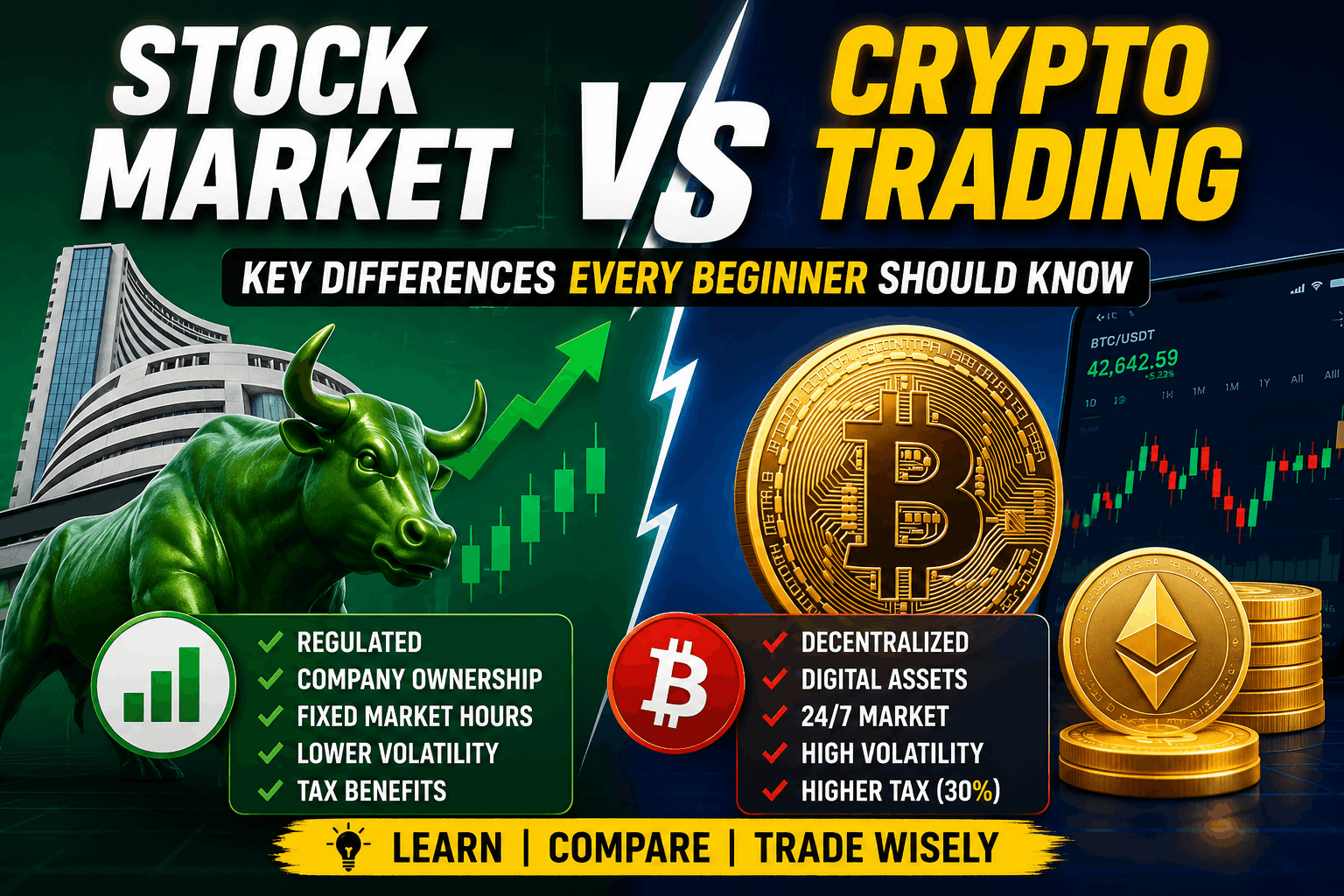

Stock Market vs Crypto Trading: Key Differences Every Beginner Should Know
Stock market trading and crypto trading are two popular ways people try to grow their money, but both are very different. A beginner should understand these differences before entering either market.
In the stock market, traders buy and sell shares of listed companies. When you buy a stock, you are buying a small ownership in that company. Stock markets are regulated, and in India, SEBI provides investor education and oversees the securities market framework. This makes stock trading more structured compared to many other high-risk markets. (SEBI Investor)
Crypto trading, on the other hand, involves buying and selling digital assets like Bitcoin, Ethereum, and other cryptocurrencies. Bitcoin is described as an open-source peer-to-peer money network and a new kind of money. (Bitcoin) Unlike stocks, cryptocurrencies are not shares of a company. Their value mainly depends on demand, supply, market sentiment, global news, technology updates, and regulations.
One big difference is market timing. Stock markets usually open and close at fixed hours. Crypto markets mostly run 24/7, which means prices can move even at night, on weekends, or during holidays.
Another major difference is risk and volatility. Stocks can also be risky, but crypto prices may rise or fall very quickly in a short time. This makes crypto trading exciting for some people but dangerous for beginners who do not understand risk management.
Regulation is also different. Stock trading is more regulated and follows defined rules. Crypto is still treated more cautiously by financial authorities in India, and RBI officials have publicly warned about risks linked to private cryptocurrencies. (The Times of India)
What is Stock Market Trading?
Stock market trading means buying and selling shares of companies through a stock exchange. When a company is listed in the stock market, people can buy its shares and become small owners of that company. Traders try to earn profit by buying shares at a lower price and selling them at a higher price.
For example, if a person buys a share at ₹500 and later sells it at ₹550, the difference becomes profit. But if the price falls to ₹450, the trader may face a loss. This is why stock market trading needs knowledge, patience, and risk management.
Stock trading is different from long-term investing. In investing, people usually buy good companies and hold them for months or years. In trading, people buy and sell more frequently. Some traders trade within the same day, which is called intraday trading. Some hold stocks for a few days or weeks, which is called swing trading.
The price of a stock can move because of many reasons. Company results, news, government policies, global markets, interest rates, demand and supply, and investor sentiment can all affect stock prices. That is why traders study charts, company updates, market trends, and financial news before making decisions.
To start stock market trading, a person usually needs a demat account and a trading account. A demat account holds shares in digital form, while a trading account is used to buy and sell them.
Stock market trading can give opportunities, but it also carries risk. Beginners should not enter the market only by following tips from social media or friends. It is better to learn the basics first, start with a small amount, avoid emotional decisions, and never trade with money needed for important expenses.
Stock Market vs Crypto Market Regulation
Regulation is one of the biggest differences between the stock market and the crypto market. For beginners, this point is very important because regulation affects safety, transparency, investor protection, and trust.
The stock market works under a proper legal and regulatory system. In India, the Securities and Exchange Board of India, or SEBI, plays a major role in regulating the securities market and spreading investor awareness. Stock exchanges, listed companies, brokers, mutual funds, and other market participants have to follow defined rules. This does not mean the stock market is risk-free, but it does mean there is a structured system for monitoring, disclosures, complaints, and investor protection. (Hindustan Times)
The crypto market is different. Cryptocurrencies are digital assets, and many of them are not controlled by a central authority like traditional stocks. In India, crypto platforms come under anti-money laundering compliance through FIU-IND rules. FIU-IND has issued AML/CFT guidelines for Virtual Digital Asset Service Providers, and crypto exchanges are expected to follow KYC and reporting requirements. (Financial Intelligence Unit)
However, crypto is still not regulated in the same way as the stock market. A recent Reuters report noted that India applies strict anti-money laundering rules and a 30% tax on crypto gains, but has not yet introduced formal full-scale cryptocurrency regulations. (Reuters)
This difference matters a lot. In the stock market, companies must share financial results, important updates, and business details with investors. In crypto, information can be less clear, and prices may move strongly because of social media trends, global news, exchange issues, or sudden regulatory updates.
Risk and Volatility Difference
Risk and volatility are two major differences between stock market trading and crypto trading. Both markets can give profit opportunities, but both can also create losses if a beginner trades without knowledge and planning.
In the stock market, prices move because of company performance, quarterly results, business news, government policies, global market trends, interest rates, and demand-supply. Stocks can be risky, but many listed companies have business history, financial reports, management details, and regulatory disclosures. This gives traders and investors some information to study before making a decision. Still, stock prices can fall sharply during bad news, market crashes, poor results, or economic uncertainty. The SEC says its role includes protecting investors and maintaining fair and efficient markets, but this does not remove market risk. (Investor.gov)
In crypto trading, volatility is usually much higher. Crypto prices can rise or fall very quickly within minutes or hours. The price of a cryptocurrency may be affected by social media trends, global regulations, exchange news, hacking incidents, liquidity, investor sentiment, and sudden buying or selling by large holders. This makes crypto trading very risky for beginners.
Another important point is that crypto markets are active 24/7. This means prices can move even while you are sleeping or during weekends. In the stock market, trading usually happens during fixed market hours, so traders get some break from continuous price movement.
For beginners, the biggest danger in both markets is emotional trading. Many people buy when prices are already high because of hype and sell in panic when prices fall. This can lead to heavy losses.
Tax Difference
Tax is another important difference between stock market trading and crypto trading. A beginner should not only think about profit and loss, but also understand how taxation works before entering any market.
In the stock market, tax depends on the type of asset and how long you hold it. For listed equity shares, equity-oriented mutual funds, and similar specified securities, short-term capital gains are generally taxed under special capital gains rules when conditions like STT payment apply. The Income Tax Department’s capital gains guidance shows that specified listed securities under Section 111A are taxed at 20% if transferred on or after 23 July 2024, while earlier transfers had a 15% rate. Long-term capital gains on eligible listed equity assets are covered separately under Section 112A. (Etds)
In crypto trading, the tax treatment is different and usually stricter. In India, income from the transfer of Virtual Digital Assets, which includes many crypto assets, is taxed under Section 115BBH. The official Income Tax Department text states that income from transfer of a virtual digital asset is taxed at 30%. It also says that deductions are generally not allowed except the cost of acquisition, and losses from VDA transfer cannot be set off against other income or carried forward. (Etds)
This makes crypto taxation less flexible compared to stock market taxation. In stock trading, the tax may depend on holding period, type of security, and capital gain category. In crypto, the tax structure is more direct and strict.
Another point is reporting. Whether you trade stocks or crypto, you should keep records of buy price, sell price, transaction dates, fees, and profit or loss. Proper records help during income tax return filing.
stock market taxation is more structured with different rules for short-term and long-term gains, while crypto taxation in India is stricter, with a flat 30% tax on VDA gains. Beginners should always check the latest tax rules before trading.
Which is Better for Beginners?
For beginners, the stock market is usually a better starting point than crypto trading because it is more structured, regulated, and easier to understand step by step. In stock trading, you are buying and selling shares of real companies. These companies have business records, quarterly results, balance sheets, management details, and official announcements. This gives beginners more information to study before making a decision.
In India, the stock market works under SEBI’s regulatory framework. SEBI also focuses on investor awareness and financial literacy, which helps new investors learn the basics in a safer way. (NISM)
Crypto trading is different. It can look attractive because prices move fast and the market is open 24/7, but this also makes it risky. A beginner may feel pressure to trade all the time. Crypto prices can rise or fall sharply due to social media trends, global news, exchange issues, regulations, or sudden market sentiment. RBI officials have also warned about risks linked with cryptocurrencies and stablecoins. (Reuters)
This does not mean the stock market is risk-free. Stock prices can also fall, and beginners can lose money if they trade without knowledge. But compared to crypto, the stock market gives a more formal learning path. A beginner can start with basic concepts like shares, mutual funds, index funds, risk management, and long-term investing before trying active trading.
Crypto may be suitable only for people who clearly understand high volatility, digital wallets, exchange safety, taxes, and the risk of losing money quickly. Beginners should avoid entering crypto just because of hype or viral profit screenshots.
stock market trading is generally better for beginners who want to learn slowly and build discipline. Crypto trading is more suitable for people who already understand market risk and can handle high volatility.
A beginner should start with small amounts, avoid borrowed money, learn before investing, and never put all savings into one market.
Disclaimer
This article is only for educational and informational purposes. It should not be taken as financial, investment, or trading advice. Stock market and crypto trading both involve risk, and prices can go up or down at any time. Crypto trading can be highly volatile, so beginners should be extra careful. Always do your own research, understand the risks, and consult a qualified financial advisor before investing or trading.