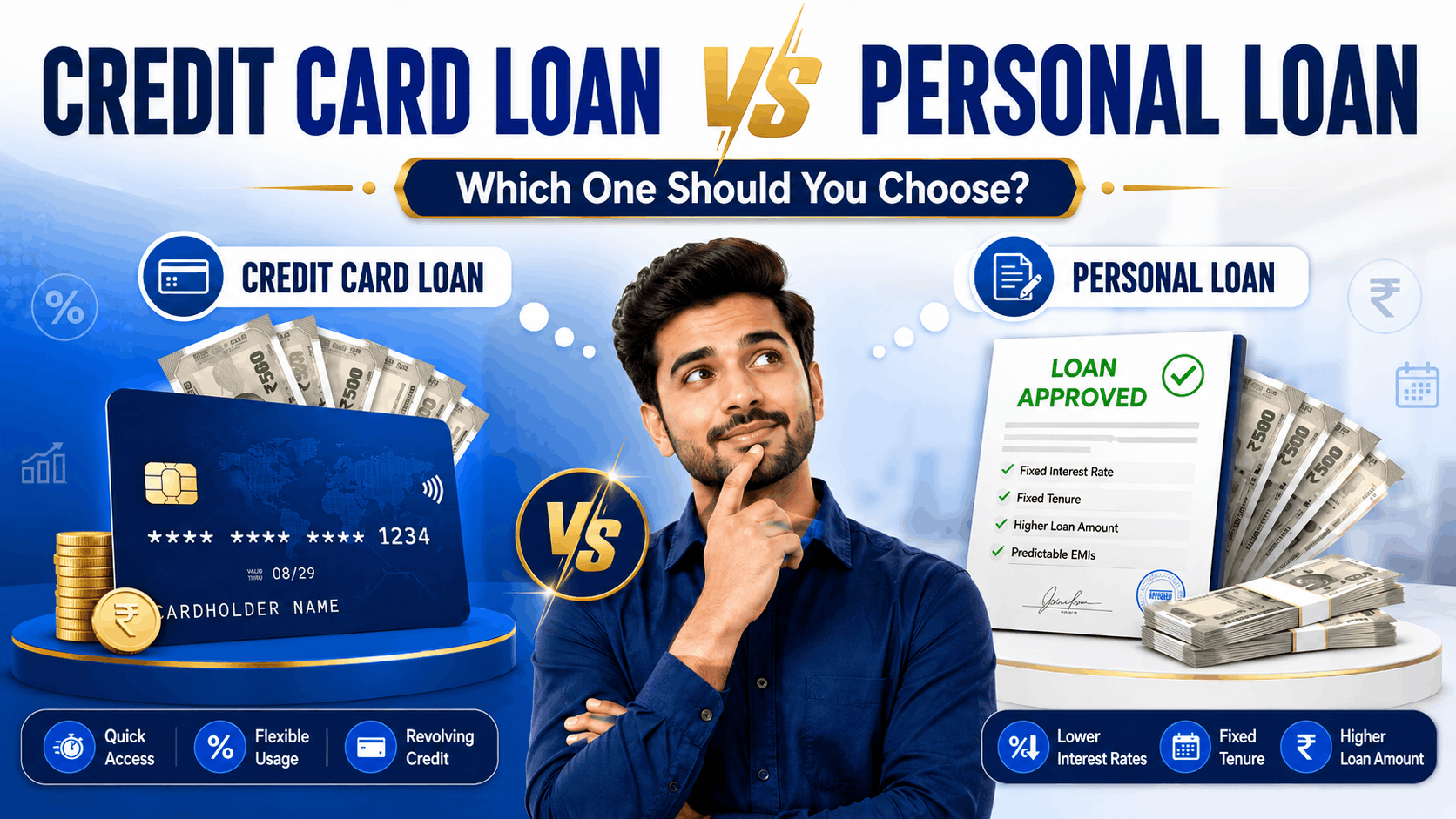

Credit Card Loan vs Personal Loan: Which One Should You Choose?
Choosing between a credit card loan and a personal loan depends on your financial need, repayment capacity, loan amount, and urgency. Both options can help you arrange money without giving any collateral, but they work differently.
A credit card loan is usually offered to existing credit card users. Banks may provide this loan based on your card usage, credit limit, repayment history, and overall profile. In many cases, it is pre-approved, so the process is fast and simple. You may not need to submit many documents because the bank already has your basic details. This makes a credit card loan useful when you need a small amount quickly.
For example, if you need money for an urgent bill, medical expense, travel booking, or short-term emergency, a credit card loan can be convenient. The amount may be transferred quickly, and you can repay it through fixed EMIs.
A personal loan, on the other hand, is a separate loan offered by banks, NBFCs, or online lenders. It is also unsecured, meaning you do not need to pledge gold, property, or any asset. However, the lender usually checks your income, credit score, job stability, bank statement, and existing loans before approval. Personal loans are generally better for bigger expenses like home renovation, wedding, education, medical treatment, or debt consolidation.
The main difference is that a credit card loan is faster, but it may be more costly. A personal loan may take slightly more time, but it can offer a higher amount, longer tenure, and better repayment structure if your credit profile is good.
If your requirement is small and urgent, and your bank is offering a reasonable credit card loan, then it can be a good choice. But if you need a larger amount and want a longer repayment period, a personal loan is usually a better option.
Before choosing any loan, do not only look at the EMI. Check the interest rate, processing fee, GST, late payment charges, prepayment rules, and total repayment amount. Also, make sure the EMI fits comfortably into your monthly budget.
Interest Rate Comparison
Interest rate is one of the most important points to check when comparing a credit card loan and a personal loan. Both loans may look similar because both are unsecured and both are repaid through EMIs, but the cost can be different.
In many cases, a credit card loan may have a higher interest rate than a personal loan. This is because credit card loans are usually quick, pre-approved, and given with minimum documentation. The bank already knows your credit card usage and repayment history, so it can offer the loan faster. But this convenience may come with a higher cost.
A personal loan may offer a better interest rate if your credit score, income, job stability, and repayment history are good. Banks and NBFCs usually check your full financial profile before approving a personal loan. If your profile is strong, you may get a lower rate and a longer repayment tenure.
However, you should not choose a loan only by looking at the interest rate. Always check the Annual Percentage Rate, also called APR. APR shows the total yearly cost of the loan, including the interest rate and other charges related to the credit facility. RBI’s Key Facts Statement rules define APR as the annual cost of credit including interest and other charges, so it gives borrowers a clearer way to compare loan offers. (FIDC)
For example, one loan may show a lower interest rate but may include a high processing fee, GST, late payment charges, or foreclosure charges. Another loan may show a slightly higher rate but lower extra charges. In such cases, the second loan may actually be cheaper.
Credit card loans are usually better for small and urgent needs, especially when the offer is reasonable and you can repay quickly. Personal loans are usually better for bigger expenses because they may offer a higher amount, lower interest rate, and longer repayment time.
Before choosing any loan, compare these points carefully: interest rate, processing fee, EMI, repayment tenure, prepayment charges, late payment penalty, and total repayment amount. The cheapest loan is not always the one with the lowest EMI. The better loan is the one that has a reasonable total cost and fits comfortably into your monthly budget.
Processing Fee and Other Charges
When comparing a credit card loan and a personal loan, many people only look at the interest rate and EMI. But this is not enough. A loan may look affordable at first, but extra charges can increase the total repayment cost. That is why processing fees and other charges should be checked carefully before accepting any loan offer.
A processing fee is the amount charged by the lender for approving and processing your loan application. In a credit card loan, the processing fee may be lower or sometimes shown as part of the offer. Since you are already an existing credit card customer, the bank may not ask for too many documents. Still, it can charge a fee for converting the amount into EMIs or disbursing the loan.
In a personal loan, the processing fee is usually charged as a percentage of the loan amount. For example, if you take a higher loan amount, the processing fee may also become higher. This fee may be deducted from the loan amount before disbursal, or it may be collected separately, depending on the lender’s policy.
Apart from processing fees, borrowers should also check GST on charges, late payment fees, EMI bounce charges, prepayment charges, foreclosure charges, documentation charges, and penal charges. These costs may look small individually, but together they can make the loan expensive.
Late payment charges are especially important. If you miss your EMI due date, the lender may charge a penalty, and it can also affect your credit score. Similarly, if you want to close the loan early, some lenders may charge a foreclosure or prepayment fee. So, before taking the loan, you should check whether early repayment is allowed and whether any extra fee applies.
Credit card loans may also have special charges related to EMI conversion or card usage. Personal loans may have more formal charges because they involve a separate loan agreement. In both cases, you should read the loan terms carefully.
The best way to compare both options is to check the total repayment amount, not just the monthly EMI. A loan with a lower EMI but longer tenure may cost more in the long run. A loan with a low interest rate but high processing fee may also not be the cheapest option.
Final Comparison: Which is Better?
When we compare a credit card loan and a personal loan, there is no single option that is best for everyone. The better choice depends on your money requirement, urgency, repayment capacity, credit score, and the offer you are getting from the lender.
A credit card loan is usually better when you need money quickly for a small or short-term need. Since this loan is often pre-approved for existing credit card users, the process can be simple and fast. You may not need to submit many documents, and the money may be available quickly. This makes it useful for urgent expenses like medical bills, travel booking, emergency repairs, or temporary cash shortage.
However, a credit card loan may not always be the cheapest option. The interest rate can be higher, and the loan amount usually depends on your credit card limit or the bank’s offer. If you already use a large part of your credit card limit, taking another loan on the card may increase your financial pressure. It can also affect your credit utilization and repayment comfort.
A personal loan is usually better when you need a higher amount and a longer repayment period. It is more suitable for planned expenses like home renovation, education, wedding expenses, medical treatment, or debt consolidation. If your credit score and income profile are good, you may get a personal loan at a better interest rate compared to a credit card loan.
Personal loans also give you a clear repayment structure. You know the EMI, tenure, interest rate, and total repayment amount from the beginning. This makes budgeting easier. But the approval process may take more time because the lender may check your income, bank statement, job stability, credit score, and existing loans.
So, if your need is small and urgent, a credit card loan can be a convenient option. But if your need is large and planned, a personal loan is generally a better choice.
Before choosing any loan, compare the interest rate, processing fee, EMI, tenure, prepayment charges, late payment penalties, and total repayment amount. Do not choose a loan only because it is easily available. Choose the loan that you can repay comfortably without disturbing your monthly budget.
Disclaimer
This article is only for general information and learning purposes. It should not be taken as financial advice. Loan rates, charges, eligibility rules, and terms can be different for every bank or lender. Before applying, always check the latest details, read the terms properly, and borrow only an amount that you can repay comfortably.