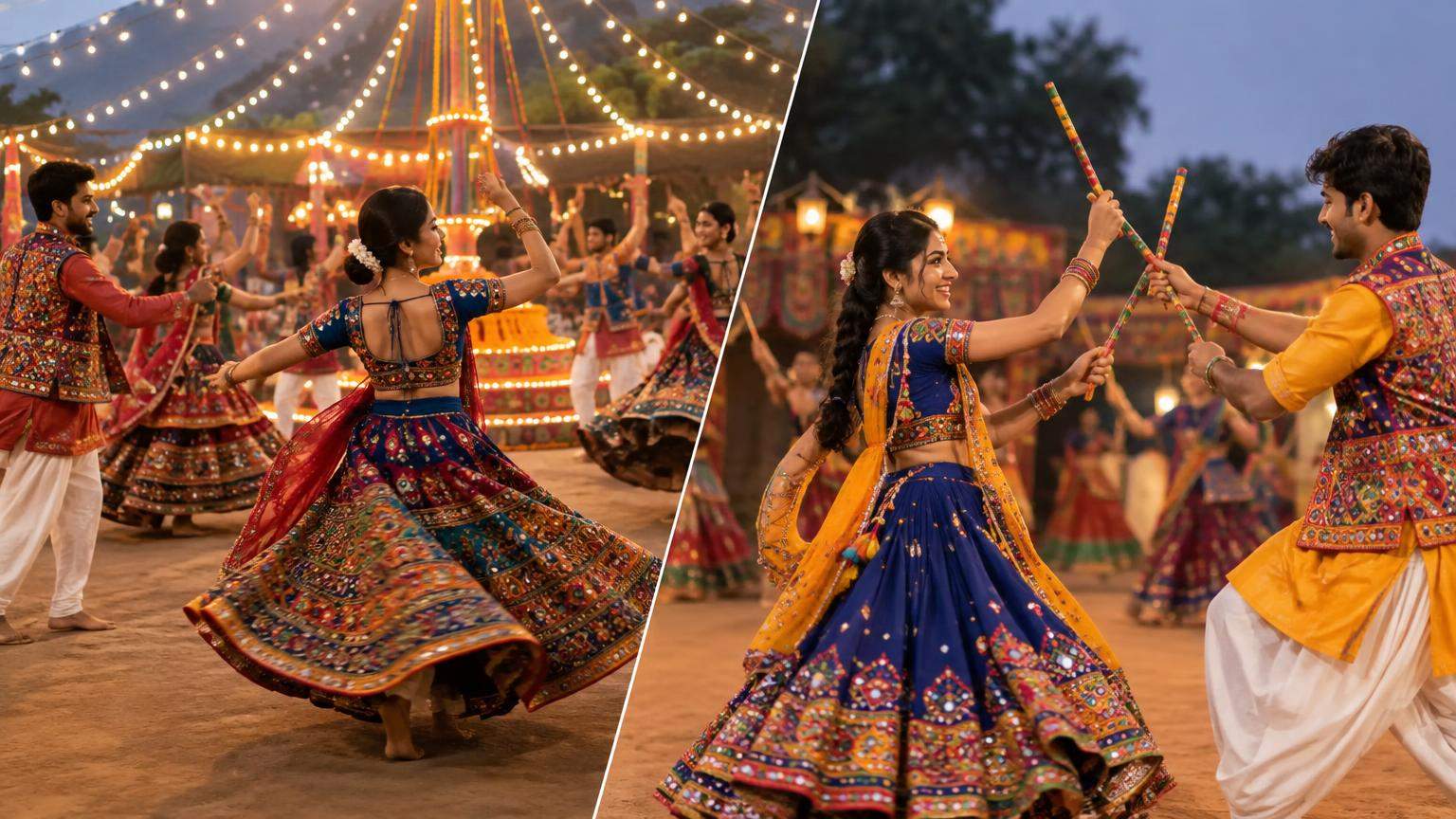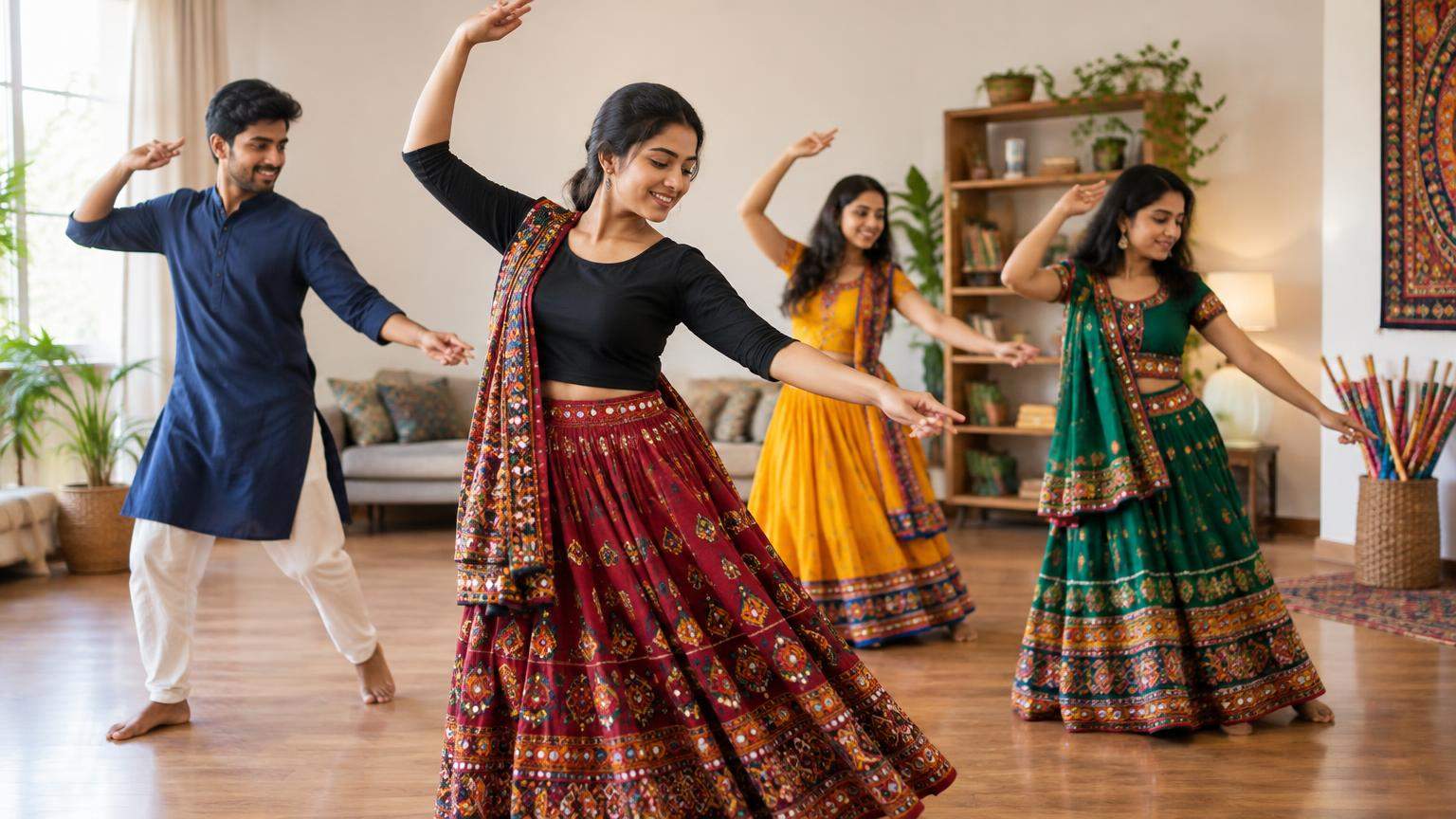

If you are looking for garba dance steps for beginners that you can comfortably learn at home before Navratri, this guide walks you through the culture, rhythm and simple patterns so you feel confident joining a real Garba circle without feeling lost.
Garba, Navratri and the Idea of Dancing in Circles
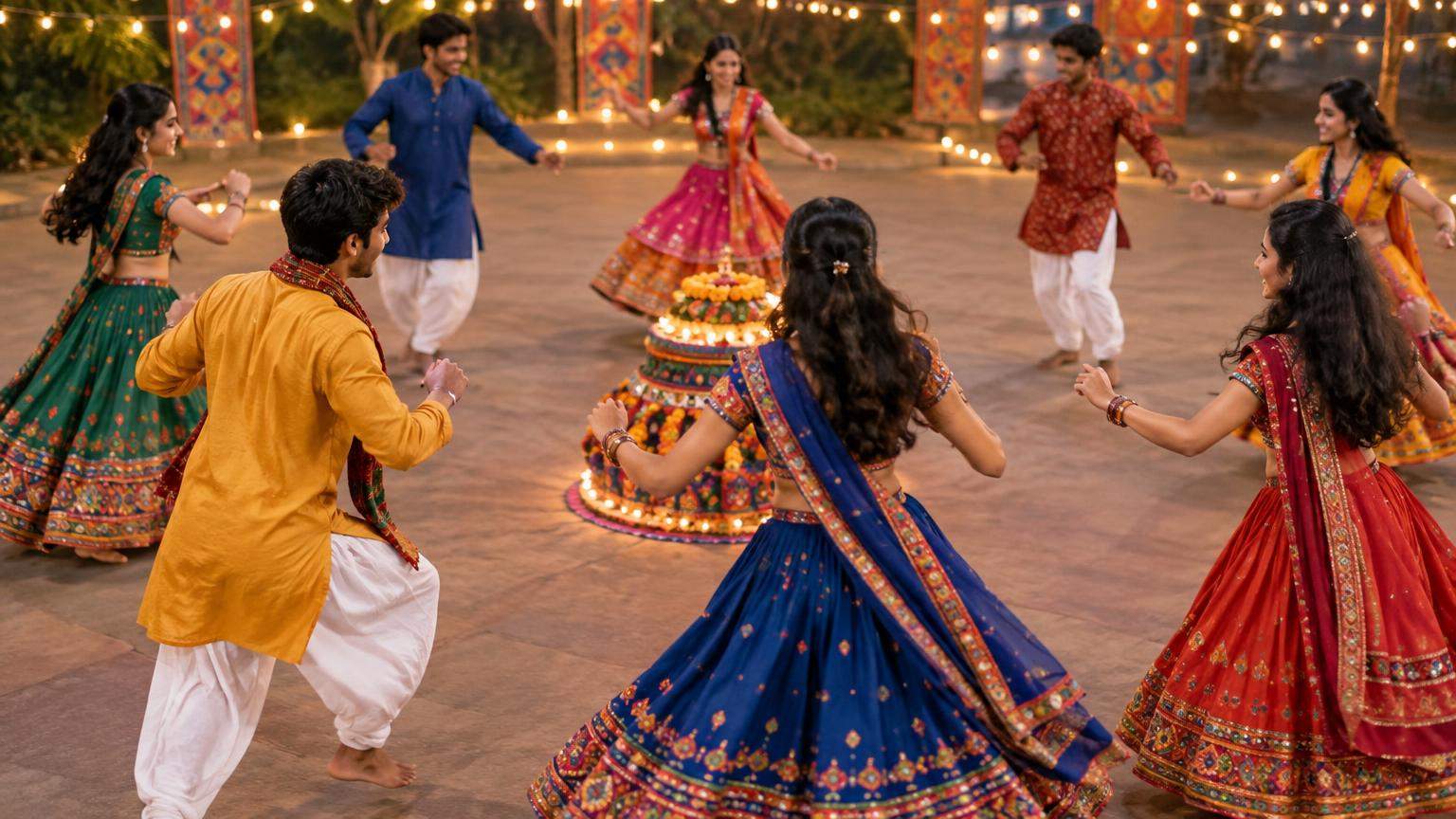
Garba is a traditional folk dance from Gujarat, usually performed in circles around a lamp or image of the goddess during the Hindu festival of Navratri. [1] The word “garba” is linked to the Sanskrit garbha (womb), and the dance celebrates the divine feminine energy (Shakti), fertility and the cycle of life. [2] In many communities, dancers move in concentric circles around a decorated clay pot with a lamp inside (often called a garbo or garbi), symbolising the goddess at the centre of the universe and the community. [3]
Navratri itself is a nine‑night festival dedicated to different forms of the goddess Durga. [4] In Gujarat, nightly Garba and related forms like Dandiya Raas are a major social and devotional highlight, bringing together people of all ages and, today, all genders. [5] At large venues, hundreds or even thousands of dancers form big circles that slowly rotate as the music builds. [4]
Garba is recognised in India’s documentation on intangible cultural heritage as a living community practice of Gujarat. [3] Importantly, this recognition emphasises that Garba is passed down informally in families and neighbourhoods, not fixed by a single official syllabus. [6] That means step names, counts and styles can change from city to city and teacher to teacher. The patterns in this guide are common beginner‑friendly versions, but when you join a local class or Navratri event, be ready to adjust to how your group dances.
Getting Ready to Learn Garba at Home
Before jumping into steps, set yourself up so practice feels safe and enjoyable.
1. Make a small practice space
You do not need a hall. A clear 2 × 2 metre area in your living room is usually enough.
- Move away chairs, centre tables and anything with sharp corners.
- Choose a flat, non‑slippery surface (tiles, wood, firm mat). Avoid loose rugs that can slide.
- If you want to connect with the traditional feeling, you can place a small lamp or photo of the goddess in the centre as your “lamp focus”, but this is optional at home. Descriptions of Garba in Gujarat emphasise dancing around a central lamp or image. [3][5]
2. Wear comfortable clothing and footwear
Navratri Garba nights are full of colourful chaniya cholis and kediyu‑dhoti outfits, but for practice you can keep it simple:
- Choose breathable clothes that allow you to lift and bend your legs easily.
- Dance barefoot or in flat shoes with a good grip; heels make balancing and turning harder, especially for beginners.
- If the floor is very hard, a thin mat or cushioned shoes can reduce strain on knees and ankles.
3. Warm up your body
Garba can become moderate to high‑intensity when done continuously, especially over several songs. Event organisers and beginner guides advise warming up and pacing yourself. [9]
Spend 5–8 minutes before each practice session on:
- Joint rotations: Gently rotate ankles, knees, hips, wrists and shoulders.
- Light cardio: March in place or do easy side steps with arm swings for a minute or two.
- Dynamic stretches: Leg swings (front–back and side–side) and gentle torso twists.
If you have any heart, joint or other health concerns, talk to a doctor before intense practice and take frequent breaks. [9]
4. Basic Garba posture
A relaxed but alert posture will make every step easier:
- Stand tall with your spine lengthened, chest open and shoulders relaxed.
- Keep your weight slightly forward over the balls of your feet (not leaning back on your heels).
- Soften your knees; avoid locking them straight.
- Let your arms hang loosely near your sides when not clapping; keep elbows slightly bent, not stiff.
This posture helps you move quickly in any direction and clap comfortably in time with the music.
Basic Rhythm and Clapping Patterns for Beginners
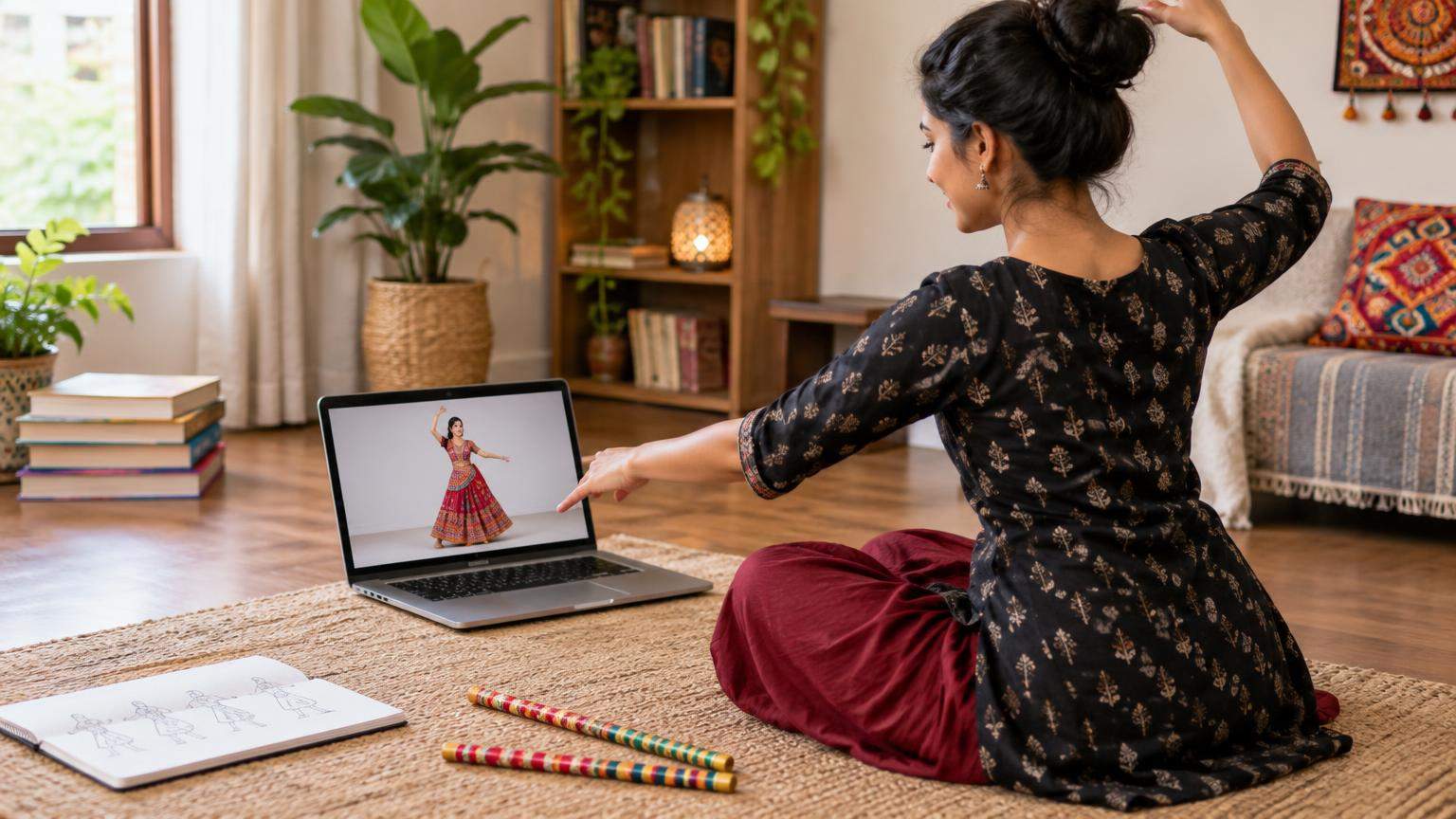
Many beginner resources agree that Garba basics are simple walking steps combined with rhythmic clapping. [1][7][9] You first learn to feel the beat, then add a two‑clap pattern (often called Be Taali or Do Taali), and then a three‑clap pattern (Tran Taali or Teen Taali).
Because traditions differ, use these as one common way to start. Your teacher or local group may count or place claps slightly differently.
Finding the beat in Garba music
Traditional Garba music uses drums like dhol and dholak, cymbals and wind instruments, along with vocals that repeat lines in cycles. [2] Modern recordings may add keyboards and electronic beats, but the feel of a steady, repeating cycle remains.
To get used to the rhythm:
- Play a relatively slow Garba track (many teaching sites recommend slower tempos for beginners). [7]
- Stand still and only clap along with the main beat—do not move your feet yet.
- Count softly: “1‑2‑3‑4‑1‑2‑3‑4” or “1‑2‑3‑4‑5‑6” depending on how you feel the cycle.
- After a minute, start walking gently on the spot while clapping on each “1”.
Your goal is to land your claps cleanly with the strongest beats of the music. Recording a short video on your phone and replaying it can help you check if you are ahead, behind or on time.
Simple two‑clap (Be Taali) pattern – step by step
Many teachers and event guides introduce the two‑clap pattern as the easiest starting step for garba dance steps for beginners. [7][9][10]
Here is a gentle, beginner‑friendly version you can practise on the spot before you start travelling in a circle:
- Stand with feet together, knees soft.
- Step your right foot slightly to the right. Shift your weight onto it (count “1”).
- Bring your left foot next to your right, or just close the gap (count “2”).
- Clap once in front of your chest (count “3”).
- Step your left foot slightly to the left (count “4”).
- Bring your right foot next to your left (count “5”).
- Clap once in front of your chest again (count “6”).
Then repeat from step 2. You are gently swaying side to side: right–together–clap, left–together–clap.
Once that feels easy, you can:
- Add a very small forward‑diagonal angle to your steps so you naturally start curving around a centre.
- Lift your clapping hands slightly towards your right side when you step right, and towards your left when you step left, to create more flow.
Remember: some teachers clap on different counts, or step three times before clapping twice, but the core idea is the same—two claps repeating in a gentle walking pattern. [7]
Simple three‑clap (Tran Taali) pattern – step by step
The three‑clap pattern is usually taught after the two‑clap and feels a little faster or more energetic. [7][9]
Here is one straightforward way to feel three claps in a six‑count cycle. Practise slowly at first:
- Stand with feet together, facing slightly towards your left (as if you are already part of a circle moving left).
- Step your right foot slightly towards your left‑front diagonal (count “1”).
- Bring your left foot up behind or next to the right (count “2”).
- Clap three times in front of your chest on counts “3‑4‑5”. Keep claps light and even.
- On count “6”, take a small adjusting step with your right foot again in the direction of travel to prepare for the next set.
You can also think of it as: step–step–clap–clap–clap–step.
As you grow more confident, teachers often add a slight pivot or turn of the body during the claps so that by the end of the three claps you have rotated a little more around the circle. [7] Keep your steps small and controlled until your balance feels secure.
Comparing two‑clap and three‑clap patterns
| Feature | Two‑clap (Be Taali) | Three‑clap (Tran Taali) |
|---|---|---|
| Typical use for beginners | First step to learn; slower and easier to balance | Next level once rhythm and balance are steady |
| Number of claps per cycle | 2 claps | 3 claps |
| Feeling | Gentle sway side‑to‑side | More energetic, slightly quicker |
| Body movement | Mostly small side steps; minimal rotation | Can include small turns or pivots as skill improves |
| Common beginner challenge | Clapping exactly on beat | Keeping three claps even and not spinning too fast |
Coordinated Footwork and Moving in a Circle
In actual Navratri events, Garba is nearly always danced in a circle around a central lamp or image. [3][6] Once your two‑clap and three‑clap patterns feel natural on the spot, the next step is to travel smoothly around an imaginary centre.
1. Mark a centre at home
Place a small object—like a cushion, lamp (safely placed) or even a water bottle—on the floor to represent the centre. This is just to help your sense of direction.
2. Walking circle with no claps
Before adding claps:
- Face slightly towards your left so your left shoulder is closer to the centre.
- Walk around the object in a wide circle, always keeping it at your left side.
- Take small, even steps; try not to drift closer or further away from the centre.
- After one full round, reverse direction (now centre is on your right) to practise both sides.
Many Garba circles move counter‑clockwise (centre on your left), but in some events inner and outer circles may go in opposite directions. Flexibility helps you adjust on the spot. [6]
3. Add two‑clap pattern while travelling
Now combine your earlier step with circle movement:
- Face slightly towards your left, standing on the outer side of your imaginary circle (centre is to your left).
- Use the same right–together–clap, left–together–clap pattern, but angle each step slightly along the curve of the circle instead of directly sideways.
- After a few cycles, you will notice you are slowly travelling around the centre.
- Check that your distance from the centre stays roughly constant; adjust the size of your steps if you are drifting.
This is very close to how you will move in an actual Garba line, just scaled down to your living room.
4. Add three‑clap pattern with gentle pivot
For the three‑clap pattern, try this once your balance is comfortable:
- Start on the outer side of the circle, facing slightly left as before.
- Take your step–step–three‑clap pattern, but during the three claps, rotate your body a little more towards your left so you align again with the circle by the final clap.
- Use very small steps and a soft bend in the knees to control the turn.
If you feel dizzy at any point, remove the rotation and keep your body facing more or less one direction until your stamina improves.
A 15‑Minute Home Practice Sequence
Because Garba is learned informally, there is no single “official” routine. However, many beginner‑focused resources suggest a similar order: rhythm first, then two‑clap, then three‑clap, then circle movement. [7][9]
Here is a simple 15‑minute practice block you can repeat a few times a week. Adjust timings based on your fitness and schedule.
Minutes 0–3: Warm‑up and rhythm
- 1–2 minutes: Joint rotations and light cardio, as described earlier.
- 1 minute: Stand still and clap with the beat of a slow Garba song, counting “1‑2‑3‑4‑1‑2‑3‑4”.
Minutes 3–7: Two‑clap on the spot
- Practise the right–together–clap, left–together–clap pattern on the spot.
- Start with slow counts (up to 6 counts per cycle) and gradually speed up until you are matching the song’s tempo.
- Focus on keeping your claps exactly in time with the music.
Minutes 7–11: Two‑clap while circling
- Place an object in the centre and begin to angle your steps to travel around it.
- Complete two or three slow rounds of the circle.
- If you feel breathless, pause for 30–60 seconds, sip water and restart.
Minutes 11–14: Introduce three‑clap
- Stop travelling and practise the step–step–three‑clap–step pattern on the spot.
- Count out loud “1‑2‑3‑4‑5‑6” to place the three claps on “3‑4‑5”.
- Keep the tempo slower than your song initially; you can mute the music to avoid pressure.
Minutes 14–15: Cool down
- Walk slowly in place while taking deeper, relaxed breaths.
- Do gentle calf, thigh and hip stretches.
Over days and weeks, extend this block by:
- Adding more minutes of continuous two‑clap circling.
- Gradually using the three‑clap pattern with small pivots as you travel.
- Trying faster songs only after you feel fully in control at slower speeds.
Common Beginner Mistakes and How to Stay Safe
Because Garba is energetic and social, beginners sometimes focus on speed and excitement more than technique and safety. Event organisers and teaching resources highlight a few frequent issues and simple fixes. [6][9]
1. Losing the beat
Problem: Clapping off‑beat or stepping randomly makes it harder to synchronise with others.
Fix:
- Go back to just clapping with the music while standing still.
- Count “1” on the strongest beat you hear and clap only on that for a while.
- Once steady, add small steps without worrying about style.
2. Taking very large steps
Problem: Over‑stretching each step can cause imbalance or collisions in a crowded circle.
Fix:
- Keep each step roughly the length of your own foot or slightly more.
- Imagine an invisible arm’s‑length bubble around you and practise staying inside it.
3. Spinning too quickly on three‑clap patterns
Problem: Fast pivots can cause dizziness, especially under bright lights and loud music.
Fix:
- Slow down the tempo and reduce the rotation—turn only a small angle with each set of claps.
- Keep your eyes softly focused at your eye level instead of looking at the floor.
- If you feel dizzy, step out of the circle, hydrate and rest. [9]
4. Ignoring body signals
Problem: Garba nights can run for hours; pushing through pain or intense breathlessness increases injury risk.
Fix:
- Take regular water breaks between songs.
- If your knees, ankles or lower back hurt, stop and rest; consider checking your footwear or the hardness of the floor.
- If you have existing health issues, talk to a medical professional about suitable intensity levels.
5. Treating online steps as the only “right” version
Problem: Many articles and videos use specific names—like Be Taali, Tran Taali, Dodhiyu—but these can look different across regions and teachers. [7][8]
Fix:
- Use online tutorials to learn common rhythms and body coordination, not to police other people’s technique.
- When you join a local group, mirror what they are doing rather than insisting on your home‑practised version.
Checklist and Next Steps
Before your first Garba night or community practice, use this quick checklist.
Technique checklist
- I can clap consistently in time with at least one slow Garba song.
- I can do a simple two‑clap pattern (right–together–clap, left–together–clap) for a few minutes without losing balance.
- I have tried a basic three‑clap pattern and can place three even claps within six counts at a comfortable speed.
- I can walk in a small circle around a centre while keeping my distance and direction stable.
Safety and comfort checklist
- My practice area is clear of obstacles and not slippery.
- I have warmed up my joints and muscles before starting.
- I keep water nearby and am ready to pause if I feel dizzy or breathless.
- Any medical conditions I have are considered, and I know my limits.
Cultural and learning mindset checklist
- I understand that Garba is a Gujarati folk dance strongly associated with Navratri and goddess worship. [2][4]
- I know that steps and names vary across communities and instructors, so I am ready to adapt. [6][8]
- I am learning at home to feel more confident, but I will stay open to guidance from live teachers and experienced dancers.
When you feel comfortable with these basics, you can explore more patterns like simple Dodhiyu or variations with hand spins and changes of direction. Many Garba step lists mention these as natural next levels after Be Taali and Tran Taali, while still emphasising regional variety. [7][8]
Frequently Asked Questions
1. Is Garba only for Gujaratis or women?
Historically, Garba in many villages was especially associated with women dancing in circles around a lamp or image of the goddess. [2][3] Today, in cities across India and in the diaspora, Navratri Garba events are open to all genders and all communities; participation is generally welcomed as long as you are respectful of the devotional and cultural context. [5]
2. Do I need a partner to dance Garba?
No. Garba is primarily a group circle dance, not a couple dance. Dancers form lines or concentric circles around a central lamp or shrine, each person following the rhythm and direction of the group. [3][6] You may sometimes dance side‑by‑side with friends, but there is no fixed “partner” requirement like in ballroom dance.
3. How long should I practise garba dance steps for beginners before going to a real Garba night?
There is no fixed timeline. Many beginners feel comfortable joining a slow Garba circle once they can:
- Keep a simple two‑clap step in time with the music for one full song.
- Walk smoothly in a circular path without bumping into others.
Start by standing in an outer circle at events, where you have more space and can observe the pattern before stepping fully into the line.
4. Can I learn Garba only from YouTube videos?
Online videos are helpful for seeing real movement, especially for garba dance steps for beginners like two‑clap and three‑clap. [10] They are a good way to start at home. However, in‑person practice teaches you spacing, speed changes, local step variations and etiquette (for example, how circles start and end, when people change steps), which are difficult to fully grasp online. Combining home learning with at least some live community practice usually leads to better confidence.
5. What if my local Garba steps look different from what I learned here?
That is completely normal. Documentation on Gujarati Garba emphasises that it is a living tradition passed down through communities rather than a single codified style. [3][6][8] Use this guide as a foundation to help you understand rhythm, posture and coordination. When you attend a real Garba event, observe how the group moves, ask someone nearby about the pattern, and be flexible in adjusting your steps.
Disclaimer
This article is an informational, beginner‑level guide based on credible cultural and educational sources about Garba and Navratri. [1][2][3][4][5] It does not claim to describe the only or “official” way to dance Garba; actual steps and names vary widely across regions, communities and instructors. The guidance here is not medical or fitness advice. Garba can be physically demanding, so if you have any health concerns or injuries, consult a qualified healthcare professional and follow their recommendations before practising. Always modify or stop movements that cause pain or discomfort, and follow local organisers’ safety instructions at any in‑person event.
Sources and Further Reading
Primary and supporting references. Verify time-sensitive information at the original publisher.
- Culture Of Gujarat — en.wikipedia.org
- Garba (dance) — en.wikipedia.org
- Doc2024716350101 — static.pib.gov.in
- Navaratri — en.wikipedia.org
- Festivals 6 — gujarattourism.com
- Gujarati Navratri Garba Circle Dance — sanatana.ekatantra.com
- Garba Steps Guide — playgarba.com
- Think You Know Garba Gujarati Dance Steps And The Stories Behind Their Names — curlytales.com
- Garba Steps For Beginners — facepassevents.com
- Watch — www.youtube.com
Research date: October 18, 2026 (UTC). Links may change.