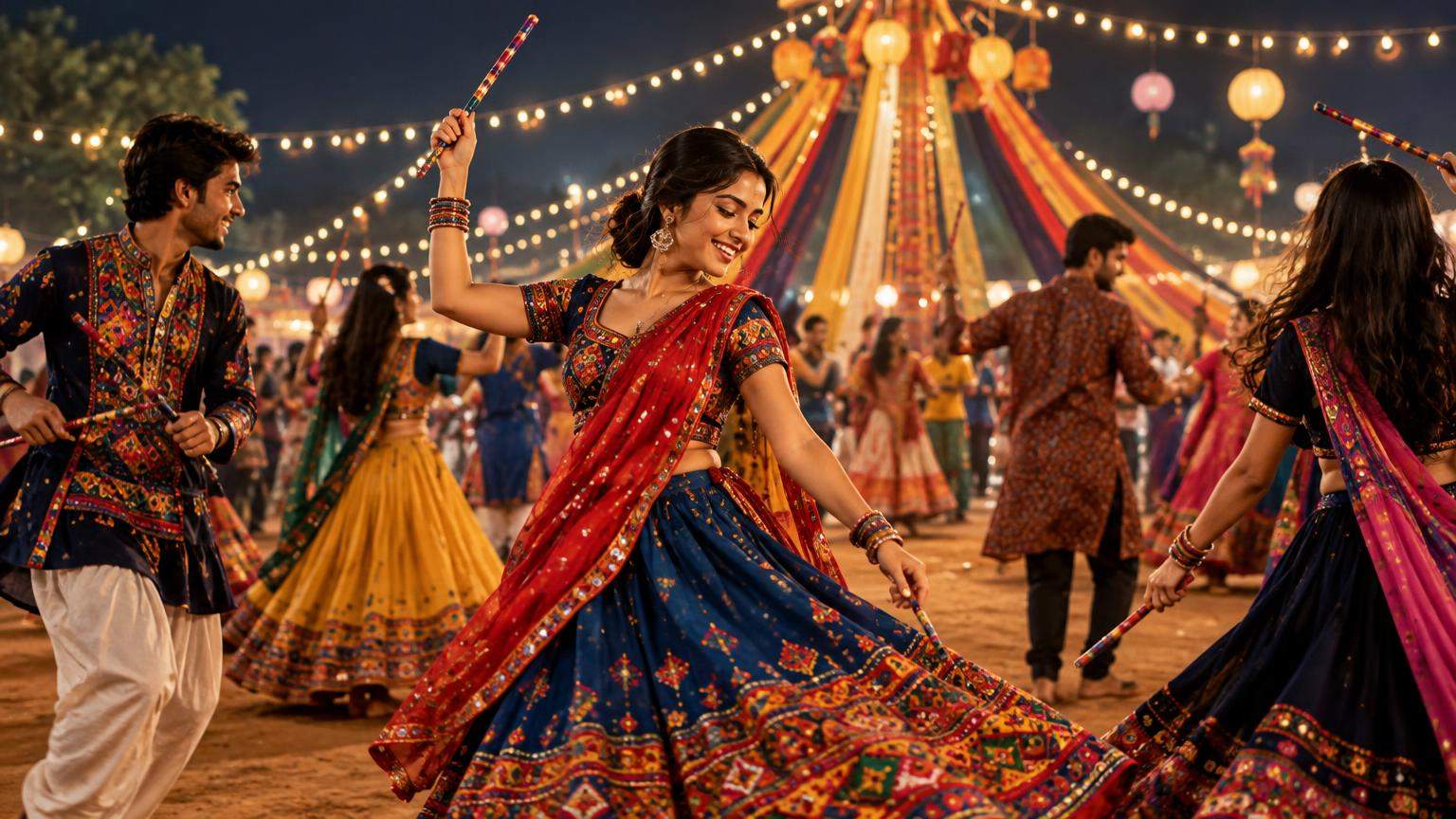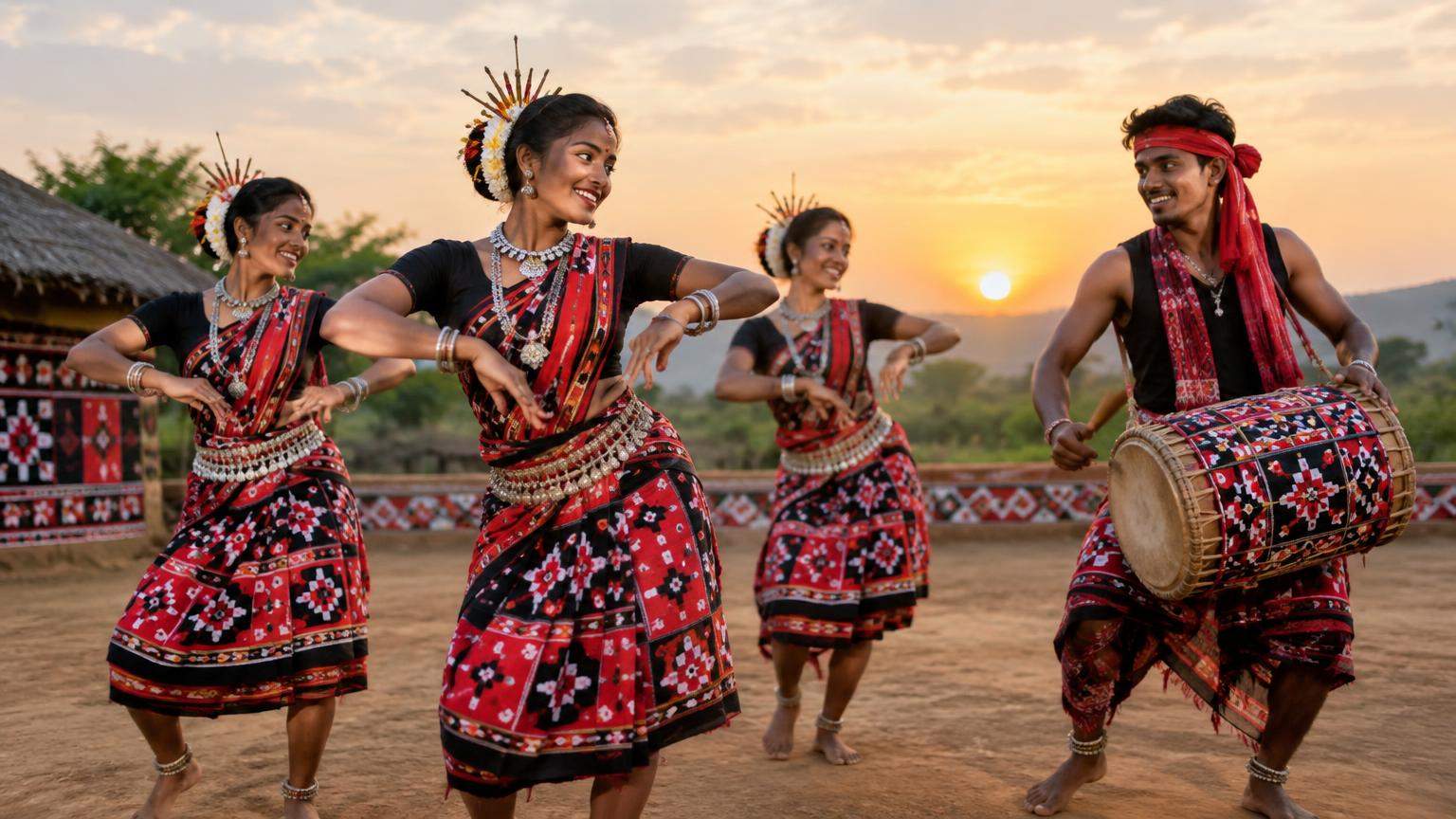

Sambalpuri folk dance is one of the most vibrant windows into the everyday life, festivals and textile heritage of western Odisha, bringing together lively drum rhythms, colourful handloom sarees and group dancing that still thrives in villages and town squares across the Sambalpuri cultural region.[1][4][5]
What is Sambalpuri folk dance?
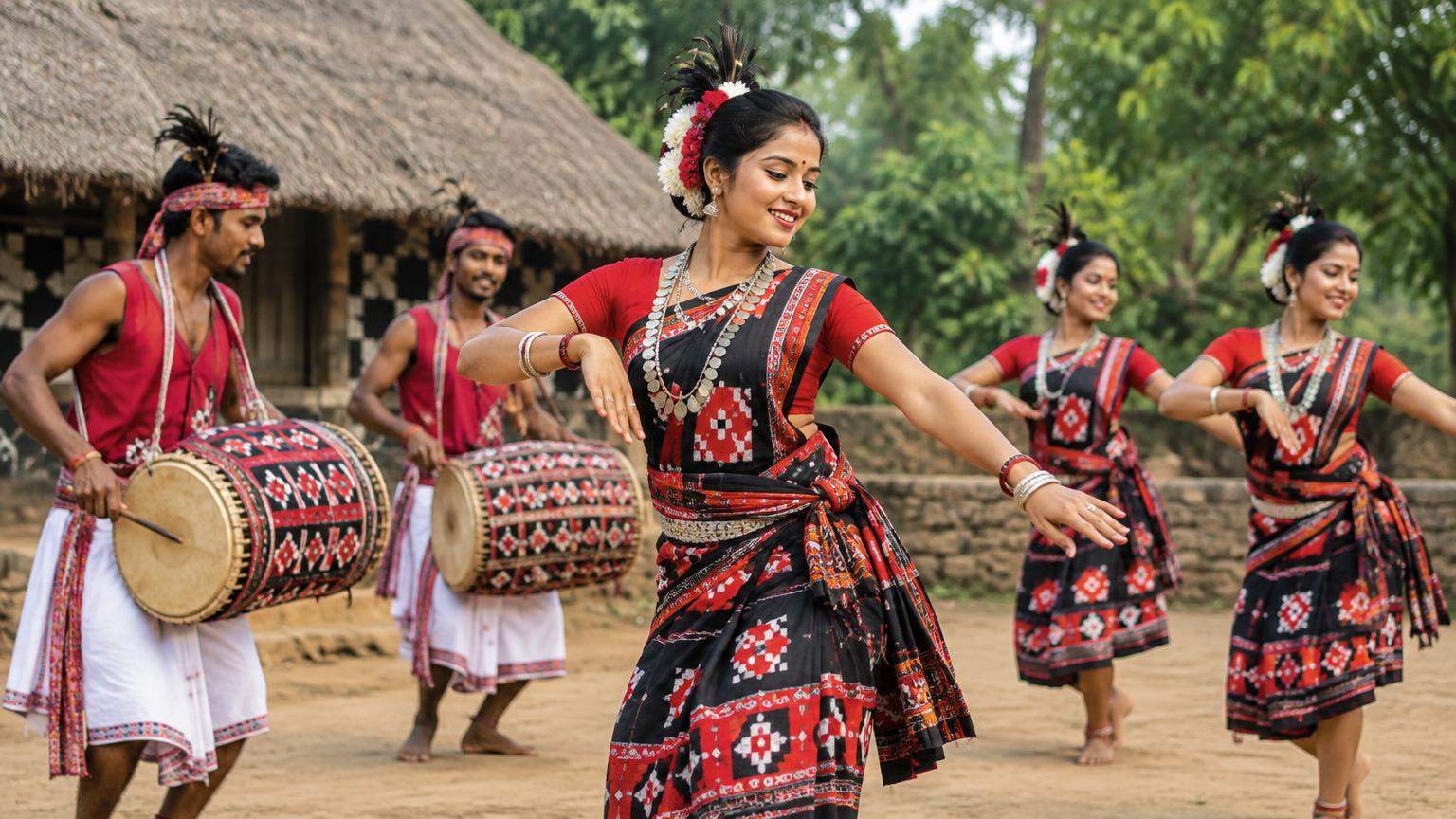
Sambalpuri folk dance is best understood as a family of village and festival dances from western Odisha, rather than a single fixed choreography. It is closely tied to the Sambalpuri language, handloom textiles and agrarian festivals such as Nuakhai in the districts around Sambalpur, Bargarh, Balangir, Sonepur and their neighbours.[1][4]
In everyday speech, people often use “Sambalpuri dance” or “Sambalpuri folk dance” to describe a recognisable regional style of group dancing to local songs and drums. Cultural and research sources, however, show that this style actually includes several distinct folk dances, including:
- Dalkhai – the best-documented dance, usually performed by young women during festivals such as Bhai Juintia, Nuakhai and Dussehra.[2]
- Rasarkeli, Maelajada, Nachnia and Bajnia – other village and festival dances mentioned in studies of western Odisha’s culture.[5][6]
- Karma (Karmā) and Dhap – ritual and tribal-rooted dances from the same broad region, recognised in lists of Odisha’s folk dances.[8][9]
All of these can be described as Sambalpuri folk dances because they share a regional language, musical style and social setting, even though each has its own name, stories and rituals.
Regional setting, festivals and community life
The Sambalpuri cultural region
“Sambalpuri culture” refers to the culture of the Mahanadi river valley districts of western Odisha. This region has its own dialect (often called Sambalpuri), distinctive folk music and dance, and world-famous handwoven textiles known as Sambalpuri sarees and fabrics.[4]
Western Odisha’s folk and tribal cultures are frequently contrasted with those of coastal Odisha. Academic work describes how the western region’s agricultural cycle, village deities and tribal communities have shaped a separate cluster of festivals and performing arts, within which Sambalpuri folk dance is central.[5]
Festivals where Sambalpuri folk dance flourishes
Most Sambalpuri folk dance is still performed in community spaces rather than formal theatres. Festivals provide the main context:
- Nuakhai – the major harvest festival of western Odisha, celebrated when the new rice is first eaten. After the daytime rituals, people gather for Nuakhai Bhetghat, where communities present Sambalpuri folk songs and dances such as Dalkhai, Rasarkeli, Maelajada, Nachnia and Bajnia.[6]
- Bhai Juintia and Dussehra – studies of Dalkhai note that it is closely associated with Bhai Juintia (a brother–sister festival) and Dussehra, when young women dance in honour of the local goddess.[2]
- Sital Sasthi – in Sambalpur town, Sital Sasthi celebrates the divine marriage of Shiva and Parvati. Cultural descriptions of the festival highlight processions and cultural programmes that include Sambalpuri folk music and dance.[3][4]
- Other village festivals – research on western Odisha lists folk dances at fairs, seasonal observances and marriage celebrations, reinforcing that these practices are woven into community life rather than limited to staged shows.[5]
For a visitor, this means that the most authentic way to experience Sambalpuri folk dance is to attend village or small-town festivals in western Odisha, where people gather informally to sing and dance long into the evening.
Music and instruments in Sambalpuri folk dance
Rhythmic foundation
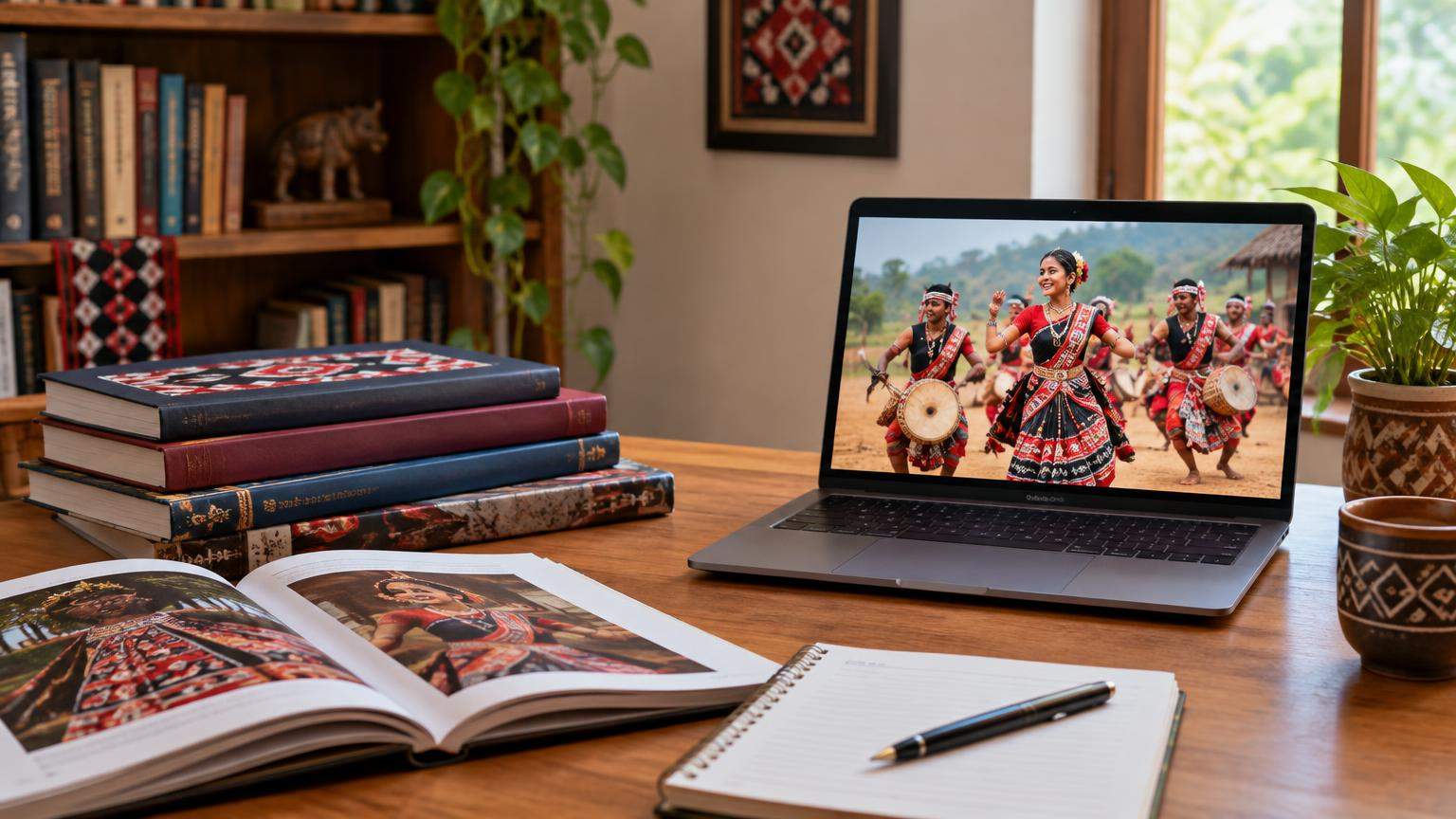
Across different named forms, Sambalpuri folk dance relies on a strong, driving rhythmic base. Research on western Odisha’s performing arts describes energetic drum patterns that support communal singing and dancing, mirroring the work rhythms of agriculture and the excitement of festival gatherings.[5]
Dancers usually move in synchrony with these rhythms, responding to the call-and-response structure of Sambalpuri folk songs. In Dalkhai, for example, a male singer or drummer may call out “Dalkhai re…”, and the line of women answers together, matching their steps and gestures to the cadence of the song.[2]
Core instruments
Different villages and troupes use slightly different ensembles, but several instruments appear repeatedly in cultural descriptions:
- Dhol or Sambalpur Dhole – a double-headed drum beaten with sticks or hands. The Sambalpur district’s cultural page notes that the “Sambalpur Dhole” can be used for many types of Sambalpuri folk songs, highlighting its central role in local performance.[10]
- Nisan – a large kettle-drum associated with processions and martial or ceremonial occasions, also mentioned in explanations of Sambalpuri dance music.[7]
- Mahuri – a piercing, conical wind instrument (similar to a shawm) common throughout Odisha in temple and folk music. Sambalpuri dance descriptions often list dhol, nisan and mahuri together as a basic ensemble.[7]
Cymbals, clapping and vocal percussion from the dancers themselves frequently add extra layers of rhythm. It is important not to treat any single combination as the only “authentic” one; written sources emphasize types of instruments rather than a fixed orchestra.[5][7]
Songs and themes
Sambalpuri folk songs are typically in the local Sambalpuri dialect and cover themes such as:
- Harvest and the beauty of rural life,
- Teasing dialogues between young men and women,
- Devotion to local deities, especially village goddesses,
- Humorous or satirical comments on everyday social relations.
Analyses of Dalkhai lyrics, for instance, show a mix of playful love imagery and devotional references to Dalkhai Devi, reflecting both everyday emotions and ritual meaning.[2] Because the songs are orally transmitted and constantly renewed, there is no single official canon; performers adapt them to new situations while retaining the core rhythmic and melodic style.[5]
Costumes and visual style
Sambalpuri handloom at the centre
One of the most striking aspects of Sambalpuri folk dance is its costume, especially for women. Academic and cultural sources consistently note that women dancers generally wear bright Sambalpuri sarees, handwoven in the region’s signature ikat (bandha) style.[4][6]
These sarees often feature motifs such as:
- Shankha (conch) and chakra (wheel),
- Pasapalli (chequerboard designs resembling dice or chess-boards),
- Stylised flowers, birds and temple-inspired patterns.
During Nuakhai, observers note groups of women performing folk dances in vibrant Sambalpuri sarees in red, blue, green or black, sometimes with contrasting borders and pallus that accentuate movement as they spin or turn.[6]
Jewellery and accessories
While there is no single codified “dress code,” several patterns appear in festival and research photographs and descriptions:[4][10]
- Traditional silver or oxidised jewellery such as necklaces, bangles and earrings.
- Fresh flowers in the hair, sometimes matching the colour of the saree.
- Waistbands or decorative belts that help keep the saree secure during energetic movement.
These elements both enhance the visual appeal and reflect regional aesthetics, but they can vary significantly from one community or troupe to another.
Male performers’ attire
Men usually appear as musicians, though some forms involve male dancers as well. Government and cultural photographs of Sambalpuri folk performances show men wearing:[4][10]
- Dhoti or lungi with a simple shirt or kurta,
- A gamuchha (handwoven towel) draped over the shoulder or used as a headcloth,
- Sometimes, colourful turbans or waistcoats for staged festival performances.
Because Sambalpuri folk dance is a living village tradition rather than a tightly regulated stage form, costume decisions tend to blend practical comfort, local custom and evolving tastes.
Group performance and movement characteristics
Lines, circles and shared energy
Descriptions of western Odisha’s folk dances emphasise that they are largely group-based. Typical formations include:[2][5]
- Rows or semi-circles of women, especially in dances like Dalkhai and Rasarkeli, facing the audience or the musicians.
- Circles or moving lines that weave through the performance space, suitable for open courtyards or village squares.
- Musicians standing or moving alongside, leading songs and rhythms to which the dancers respond.
In Dalkhai, specific studies note that unmarried girls form a line or semi-circle, stepping and swaying together while responding to the lead singer’s calls.[2] The collective nature of these formations symbolises cooperation and shared joy, echoing agricultural team work.
Typical movement qualities
Unlike classical Odissi, Sambalpuri folk dances are not governed by a written technique manual. Still, several movement characteristics are widely described:[2][5]
- Rhythmic footwork that marks the strong beats of the dhol, often involving stamping, small hops and travelling steps.
- Swinging arms and torso, with side-to-side sways that suggest play and companionship.
- Bends and slight turns of the upper body that give a sense of elasticity and joy.
- Clapping and hand gestures timed to the song’s refrain, sometimes echoing daily activities or playful teasing.
Because these dances are transmitted orally and by imitation, the exact sequence of steps can vary from one village to another. For learners and observers, it is more accurate to think in terms of shared movement vocabulary and feeling rather than a rigid, standardised choreography.
Sambalpuri folk dance and its main forms
Umbrella term vs specific dances
Contemporary cultural summaries and academic work treat “Sambalpuri folk dance” as a regional umbrella term. Within that umbrella, researchers list distinct dances such as Dalkhai, Rasarkeli, Karma, Dhap, Maelajada, Nachnia and Bajnia.[1][5][8][9]
A useful way to think of this is:
- Sambalpuri folk dance – the overall tradition of folk dances from western Odisha.
- Dalkhai, Rasarkeli, Karma, Dhap etc. – named styles within the Sambalpuri region, each tied to particular rituals, communities or times of year.
Dalkhai: a leading women’s dance
Academic studies identify Dalkhai as one of the most prominent Sambalpuri folk dances.[2] Key features include:
- Primarily danced by unmarried girls and young women in villages.[2]
- Performed during festivals such as Bhai Juintia, Nuakhai, Dussehra and Phagun Puni in districts including Sambalpur, Bargarh, Balangir, Sonepur, Kalahandi and nearby areas.[2]
- Involves a distinctive call-and-response singing pattern where the leader calls “Dalkhai re…” and the line of dancers answers together.[2]
Although Dalkhai now appears on urban and even national stages, scholars emphasise that it remains deeply rooted in village rituals and local goddess worship.[2]
Other Sambalpuri dance forms
Within the Sambalpuri folk tradition, several other documented dances stand out:
- Rasarkeli – often mentioned alongside Dalkhai in descriptions of Nuakhai and other festivals as a playful, group-based dance of youth.[5][6]
- Karma (Karmā) and Sambalpuri Karma dance – a ritual dance associated with the Karma festival during the agricultural season, recognised among Odisha’s folk dances.[8]
- Dhap dance – linked to tribal communities and centred on the dhap drum; listed as a western Odishan folk form.[9]
- Maelajada, Nachnia, Bajnia – dances associated with village festivities and performance troupes, especially visible during Nuakhai Bhetghat evenings.[5][6]
While detailed choreographic descriptions for these forms are limited in written sources, their naming and festival associations show how rich and varied Sambalpuri folk dance is within a relatively compact region.
Comparison: Sambalpuri folk dance vs specific forms
| Aspect | Sambalpuri folk dance (umbrella) | Dalkhai | Karma (Sambalpuri Karma) |
|---|---|---|---|
| Scope | Overall tradition of folk dances from western Odisha. | One specific women’s dance form within that tradition. | Specific ritual harvest dance within the same region. |
| Main performers | Varies: women’s groups, mixed groups, tribal communities. | Primarily unmarried girls/young women.[2] | Rural and tribal communities during Karma festival.[8] |
| Occasions | Nuakhai, Sital Sasthi, weddings, village fairs and other festivals.[5][6] | Bhai Juintia, Nuakhai, Dussehra, Phagun Puni.[2] | Karma festival in the agricultural season.[8] |
| Music | Local folk songs with dhol, nisan, mahuri and other percussion.[7][10] | Call-and-response Dalkhai songs with drums and wind instruments.[2] | Songs honouring the Karma tree and associated deities, with drums and clapping.[8] |
This comparison highlights that “Sambalpuri folk dance” is a regional label, while dances like Dalkhai and Karma are distinct forms within it.
Beginner’s guide: how to watch and start learning respectfully
Start as an attentive observer
Because Sambalpuri folk dance is a community tradition transmitted informally, the safest way to begin is by watching live performances in context:
- If you are in Odisha around Nuakhai, attend evening cultural programmes or village Bhetghat gatherings where local groups present Dalkhai, Rasarkeli or other Sambalpuri dances.[6]
- During Sital Sasthi in Sambalpur, look for folk-dance performances advertised as part of the festival’s cultural events.[3][4]
- Community festivals, college cultural weeks and district-level folk festivals in western Odisha often include Sambalpuri dance items.[5][10]
When you watch, try to notice:
- How the drum rhythms drive the dancers’ steps.
- Where the dancers stand in lines, circles or semi-circles.
- How call-and-response singing affects their timing and gestures.
- How costumes and jewellery move with the body and emphasise patterns.
Learning from experienced practitioners
If you wish to go beyond observation, look for opportunities to learn directly from people rooted in the tradition:
- Ask festival organisers or local cultural officers in western Odisha (for example, in Sambalpur or Bargarh) whether there are folk troupes or community groups open to teaching newcomers.[10]
- In cities of Odisha and in Odia diaspora communities, some cultural associations conduct workshops or rehearsals for Sambalpuri folk items during festival seasons. These can provide introductory exposure, though styles may be adapted for the stage.[4][6]
Because there is no universally standardised syllabus for Sambalpuri folk dance in the literature, avoid any source that claims to present the only correct step sequence. Instead, treat your teachers as representatives of a particular village or troupe tradition.
For experienced dancers who want to introduce students to Odisha’s classical and folk traditions, our guide to starting online Odia dance classes explains how to plan lessons, choose teaching platforms and organise beginner-friendly courses.
Using recordings wisely
Online videos and recordings can be helpful in familiarising yourself with typical rhythms, songs and formations. However:
- Use them mainly to train your ear and eye – observe patterns of movement, costume and musical phrasing.
- Do not assume that a single popular video reflects all villages’ practices; field research shows that details of performance vary widely.[5]
- When in doubt, prioritise guidance from local practitioners over what you see online.
If you are a Sambalpuri dance performer interested in sharing your work with a wider audience, explore our guide on how to turn your Odia dance skills into a personal brand or business. It discusses building an online presence and presenting your dance skills to potential audiences.
Cultural sensitivity and safe participation
Many Sambalpuri dances are closely connected to rituals, deities and women’s community spaces. To participate respectfully:
- Ask whether a particular dance, such as Dalkhai during a religious observance, is open to all or intended primarily for local women and girls.[2]
- If you are an outsider or visitor, it is often more appropriate to observe quietly during the core ritual and join in only if organisers explicitly invite general participation later.
- Avoid staging or costuming that turns sacred or community-rooted dances into caricature or purely commercial display. Research on western Odisha stresses the deep identity value attached to these arts.[5][6]
When learning, pay attention not just to steps and songs but also to the stories and meanings your teachers share. This helps keep the tradition’s cultural context alive alongside its physical form.
Frequently Asked Questions
Is Sambalpuri folk dance the same as Odissi?
No. Odissi is a classical Indian dance form with a codified technique, repertoire and training system, whereas Sambalpuri folk dance refers to community-based village dances from western Odisha that are passed on informally, often at festivals and social gatherings.[3][5] The two coexist within the state’s cultural landscape but have different histories, aesthetics and social roles.
Is Sambalpuri folk dance a “tribal” or “rural” dance?
Western Odisha has a significant presence of tribal communities, and many dances such as Dalkhai, Dhap and Karma have roots in Adivasi or rural agrarian life.[5][9] Today they are performed by a wide range of people—tribal and non-tribal, rural and urban—especially during festivals like Nuakhai, so it is more accurate to see them as regional folk traditions with strong tribal and village contributions.
Can men learn and perform Sambalpuri folk dance?
Yes, but with nuance. Some dances, notably Dalkhai, are documented primarily as dances of unmarried girls and women.[2] Others, such as Karma and certain village festival dances, involve male dancers or mixed groups.[8][9] Men frequently participate as musicians. If you are interested in learning, ask local practitioners which forms are appropriate for you to join in a given context.
How is Sambalpuri folk dance changing today?
Scholarly and cultural sources note that Sambalpuri dances that were once mostly confined to villages now appear at district, state and national cultural festivals, often on formal stages and in choreographed presentations.[3][5] While this helps raise visibility and pride in Sambalpuri identity, it can also lead to stylised versions that differ from village practice. Both streams—community-based and staged—currently coexist.
Do I need to wear a Sambalpuri saree to dance?
For formal performances, troupes typically choose Sambalpuri handloom costumes to reflect the dance’s regional identity.[4][6] For learning in workshops or practice sessions, comfortable clothing that allows free movement is usually sufficient unless teachers specify otherwise. If you do wear Sambalpuri textiles, treat them with respect as products of a long-standing weaving tradition.
Disclaimer
This guide to Sambalpuri folk dance is based on published research, government cultural information and reputable cultural summaries available at the time of writing.[1][3][5] Because these dances are living, community-based traditions, details of performance, costume and participation can vary between villages, communities and troupes, and they may change over time.
The article does not offer a definitive choreographic manual or authority on ritual practice. For accurate, current and locally appropriate guidance, readers should consult practising artists, community elders and relevant cultural institutions in western Odisha.
Sources and Further Reading
Primary and supporting references. Verify time-sensitive information at the original publisher.
- Sambalpuri Folk Dance Odisha — www.wriksh.com
- 272 — al-kindipublisher.com
- Culture Music Dance — odishatourism.gov.in
- Sambalpuri Culture — en.wikipedia.org
- 197 — www.onlineresearchjournals.com
- 390032667 NUAKHAI FROM A FOLK RITUAL TO A CULTURAL IDENTITY OF WESTERN ODISHA — www.researchgate.net
- Sambalpuri Dance — odiapedia.com
- List Of Indian Folk Dances — en.wikipedia.org
- Folk Dance Forms Of Odisha — en.wikipedia.org
- Culture Heritage — sambalpur.odisha.gov.in
Research date: October 19, 2026 (UTC). Links may change.