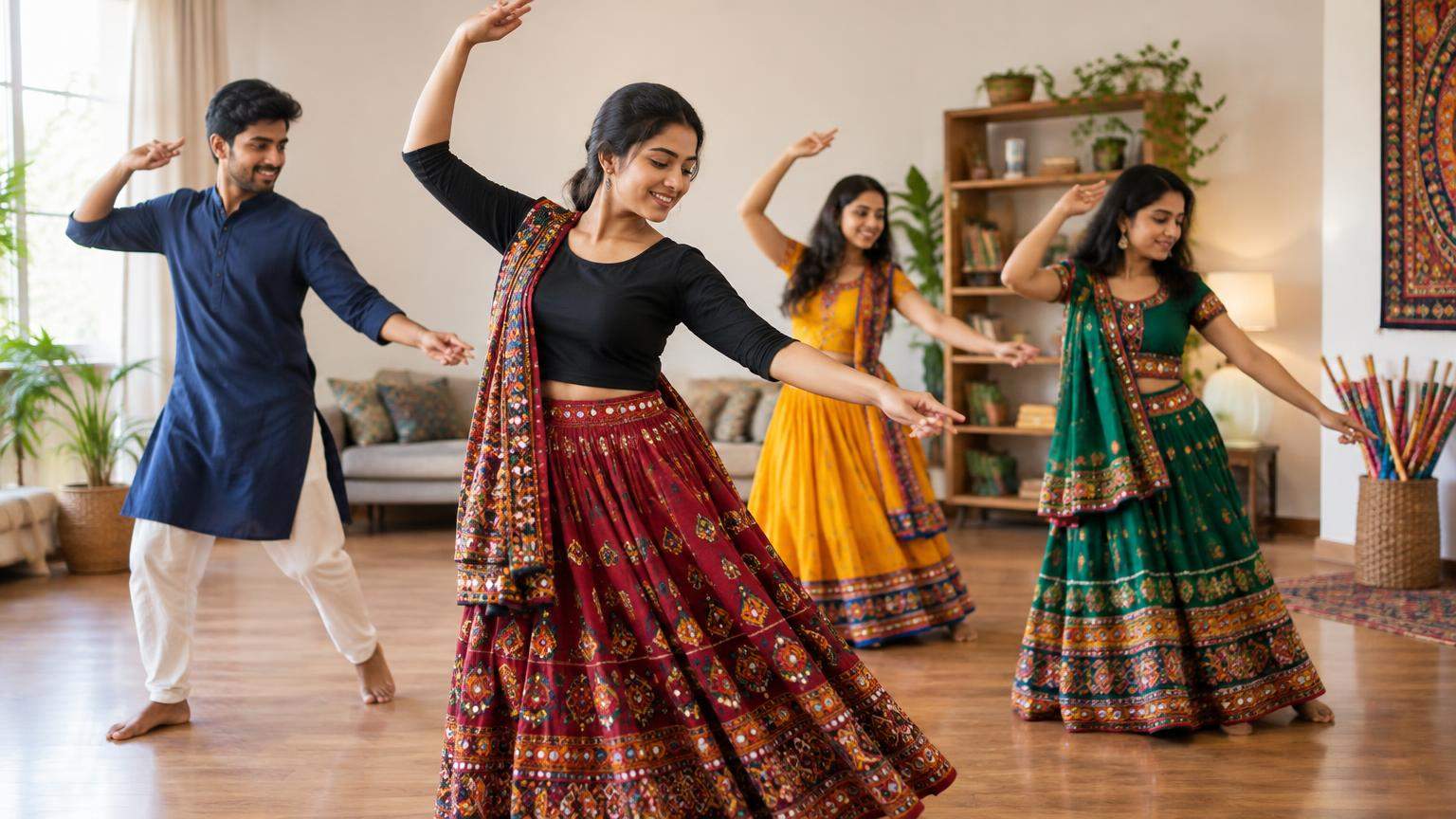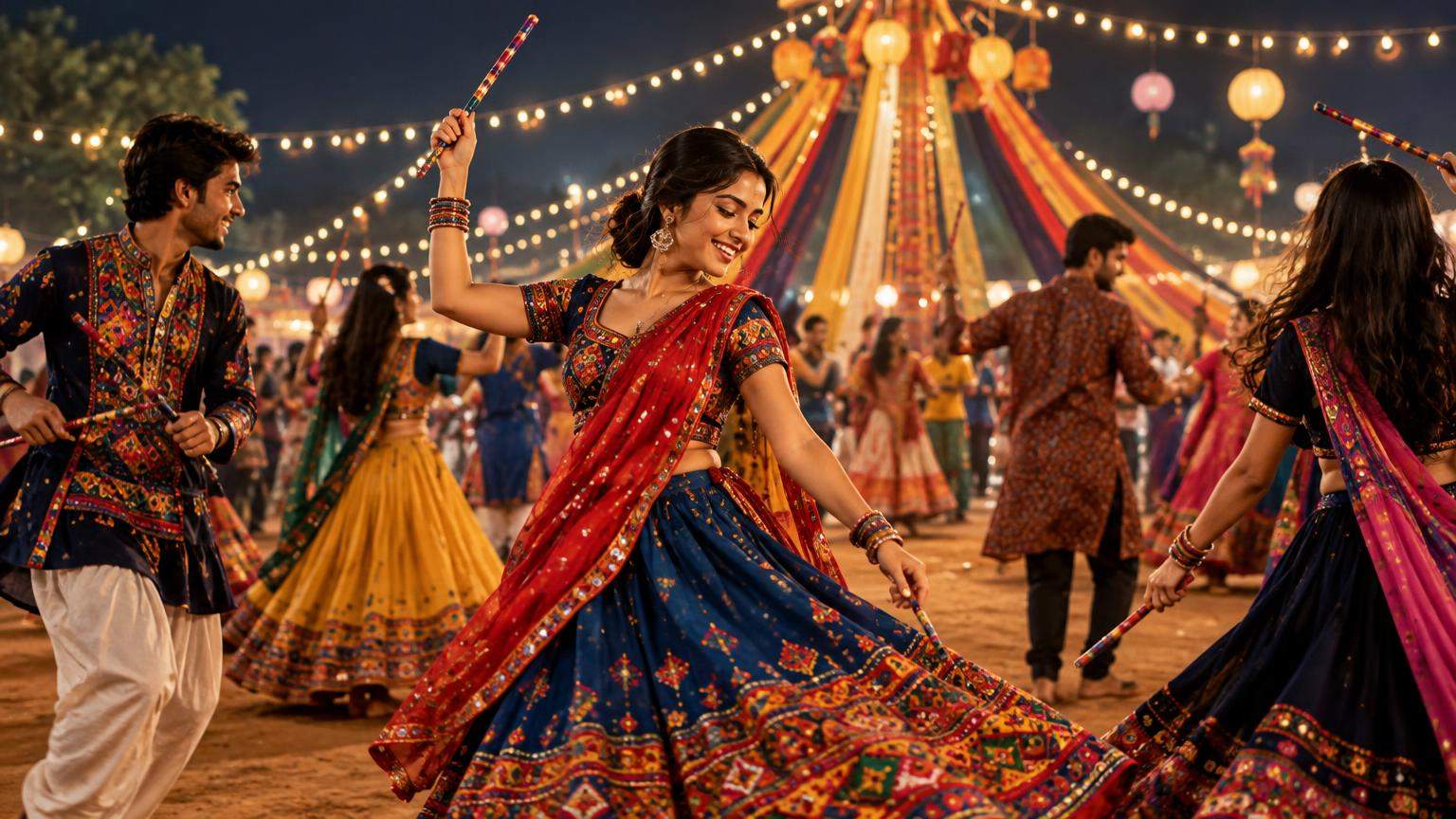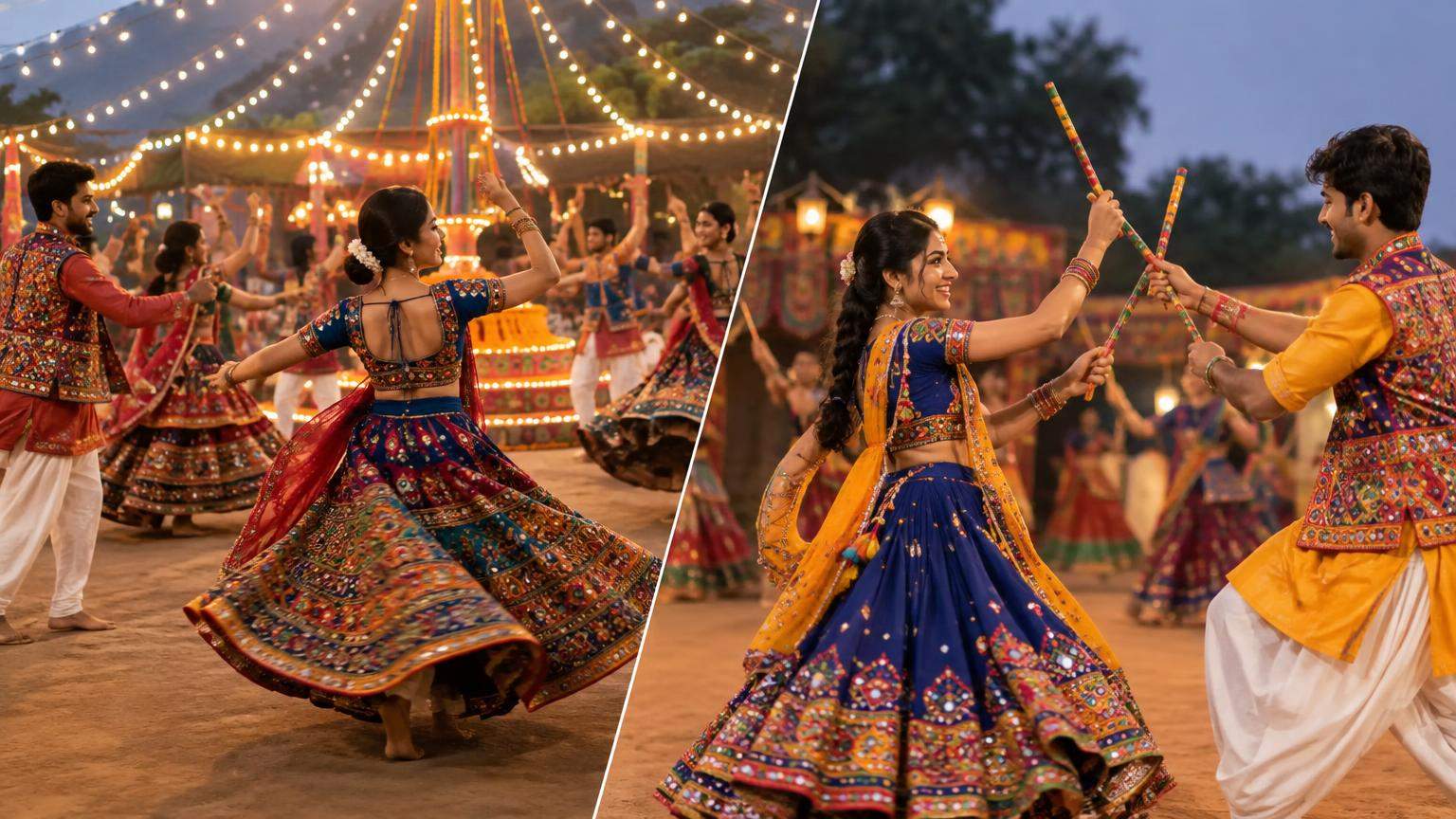

Garba vs dandiya is a comparison many people ask about just before Navratri: both dances look festive and circular, the same bands often play for both, yet the feeling and technique on the floor are quite different. This guide walks you through how Garba and Dandiya Raas relate to each other, where they differ in steps, music and traditions, and what that means if you are a beginner planning to join Navratri celebrations in India.
What exactly is being compared?
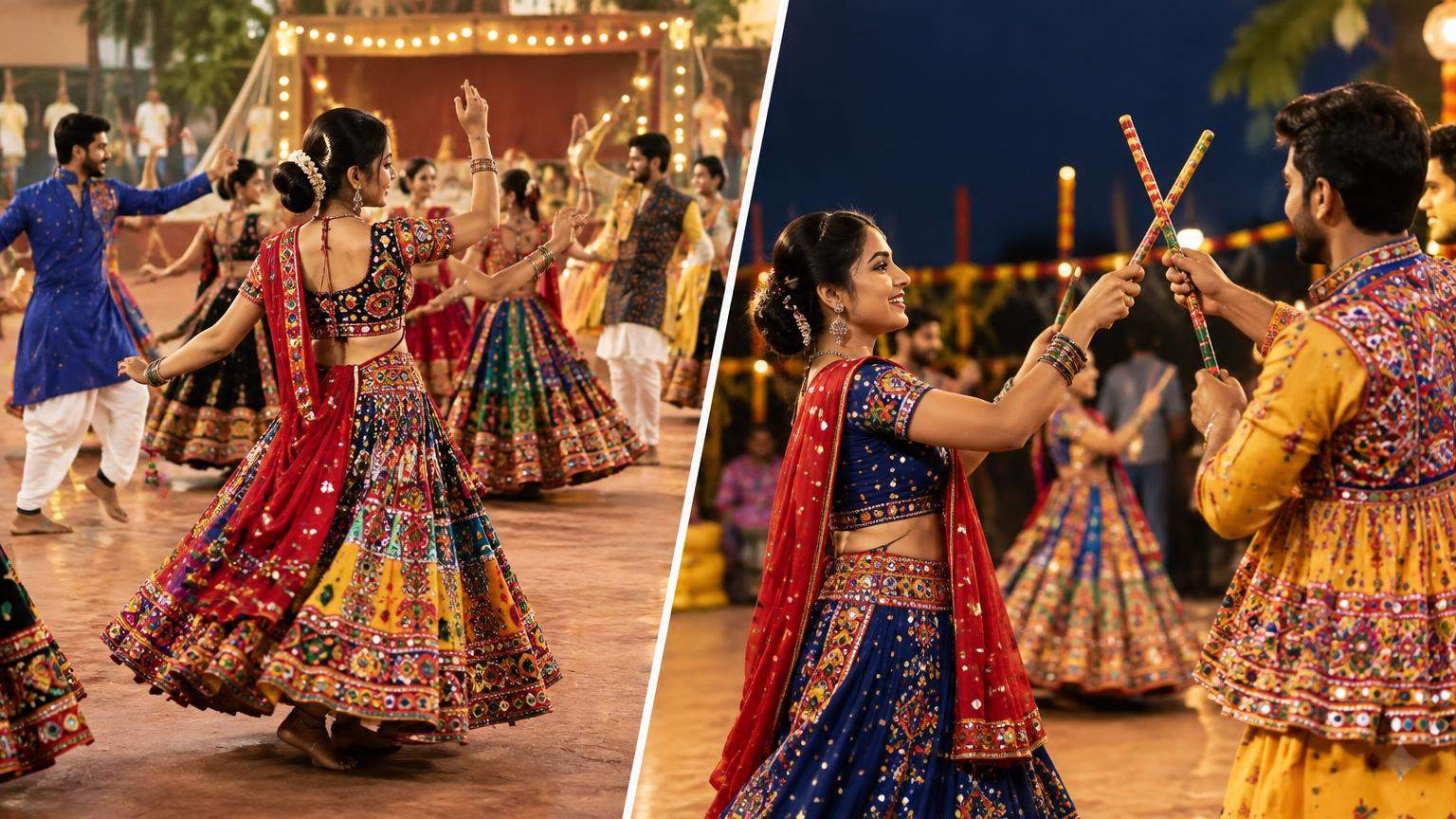
Garba and Dandiya Raas are sister folk traditions from Gujarat that now appear at Navratri celebrations across India and in the diaspora. Both are community dances linked to devotion to the goddess during the nine nights of Navratri, and both are recognised as significant parts of Gujarati culture. [1][8]
Yet they are not the same dance.
- Garba is a circular devotional dance performed around a lamp or image of the goddess, using coordinated steps, claps and arm movements, traditionally without sticks. [2][4]
- Dandiya Raas (often shortened to “dandiya” or just “raas”) is a high‑energy stick dance, usually performed in pairs or facing lines, where wooden dandiyas are struck together in rhythmic patterns. [3][9]
At many Navratri venues you will hear organisers announce “Garba first, then Dandiya,” and you may see the same dancers shift from flowing hand‑and‑foot work to animated stick patterns. A children’s cultural explainer from India notes that Garba is often performed before the aarti, while Dandiya frequently follows as a more playful celebration, although actual event schedules vary by region and organiser. [10]
Because both forms have travelled far beyond their original village and temple settings, you will also find hybrid “raas‑garba” choreographies and Bollywood‑style routines. Gujarati cultural studies emphasise that there is no single frozen version of either dance; instead there are many local and family styles. [5]
Garba: devotional circles around the lamp
Garba is one of the most prominent folk expressions of Gujarat, and in 2023 “Garba of Gujarat” was inscribed on UNESCO’s Representative List of the Intangible Cultural Heritage of Humanity. [2][7]
UNESCO and Indian cultural reporting describe it as a ritual‑cum‑recreational dance performed in circles around a central motif—often an earthen pot with a lamp (garbo/garbha‑deep) or an image of the goddess. [2][4]
Symbolism and setting
Garba’s circular movement is widely explained as symbolising the cyclical nature of time and the continuous presence of the divine feminine energy (Shakti). The central lamp in the pot is linked to the womb and fertility, representing the goddess at the heart of the community. [2][4]
Historically, Garba was associated with courtyards and temple spaces, with women dancing in circles; over time, men joined in and large public grounds, club lawns and stadiums became typical venues during Navratri. [1][4]
Movement patterns and steps
Ethnographic material and Gujarati folk‑culture texts describe Garba as a circular dance with coordinated footwork and upper‑body movements. [2][5]
Common elements include:
- Stepping in a circle: Dancers travel around the centre in one or more circles, often in an anti‑clockwise direction, sometimes changing direction with the music.
- Basic step counts: Teachers and cultural notes often reference simple 2‑step, 4‑step or 6‑step patterns as a starting point, with more complex variations layered on top. [5]
- Hand movements: Claps (taali), graceful arm sweeps, and occasional spins; some styles emphasise hand gestures more than clapping.
- Variations: Named patterns such as tran‑taali (three claps), dodhiya and others, which different regions and troupes interpret in their own ways. [5]
Because Garba is a living tradition rather than a codified studio dance, patterns are not identical from city to city. A village Garba may look different from a choreographed competition in a metro, even though the circular movement around a central lamp or idol remains a strong visual marker. [2][5]
Music and rhythm
Garba songs are typically devotional Gujarati compositions in praise of forms of the goddess, sung or played in lilting, cyclical rhythms that support the continuous circular motion of the dance. [1][8]
Navratri overviews describe Garba music as often using rhythmic patterns that feel medium‑paced and flowing rather than purely percussive. Modern Garba events may incorporate amplified folk orchestras, drum sets and even remixed tracks, but the lyrical, call‑and‑response feeling of traditional Garba songs remains influential. [4][8]
Dress and atmosphere
Both men and women typically wear brightly coloured, mirror‑worked Gujarati outfits during Garba: chaniya choli for women and kediyu‑style tops with dhoti or churidar for men, sometimes with turbans and waistcoats. [1][3]
The overall atmosphere, especially in the early part of the evening, tends to be devotional and community‑oriented. UNESCO highlights Garba’s role in bringing together people of different ages and backgrounds, strengthening social bonds through shared movement and music. [2]
Dandiya Raas: energetic stick play and partner patterns
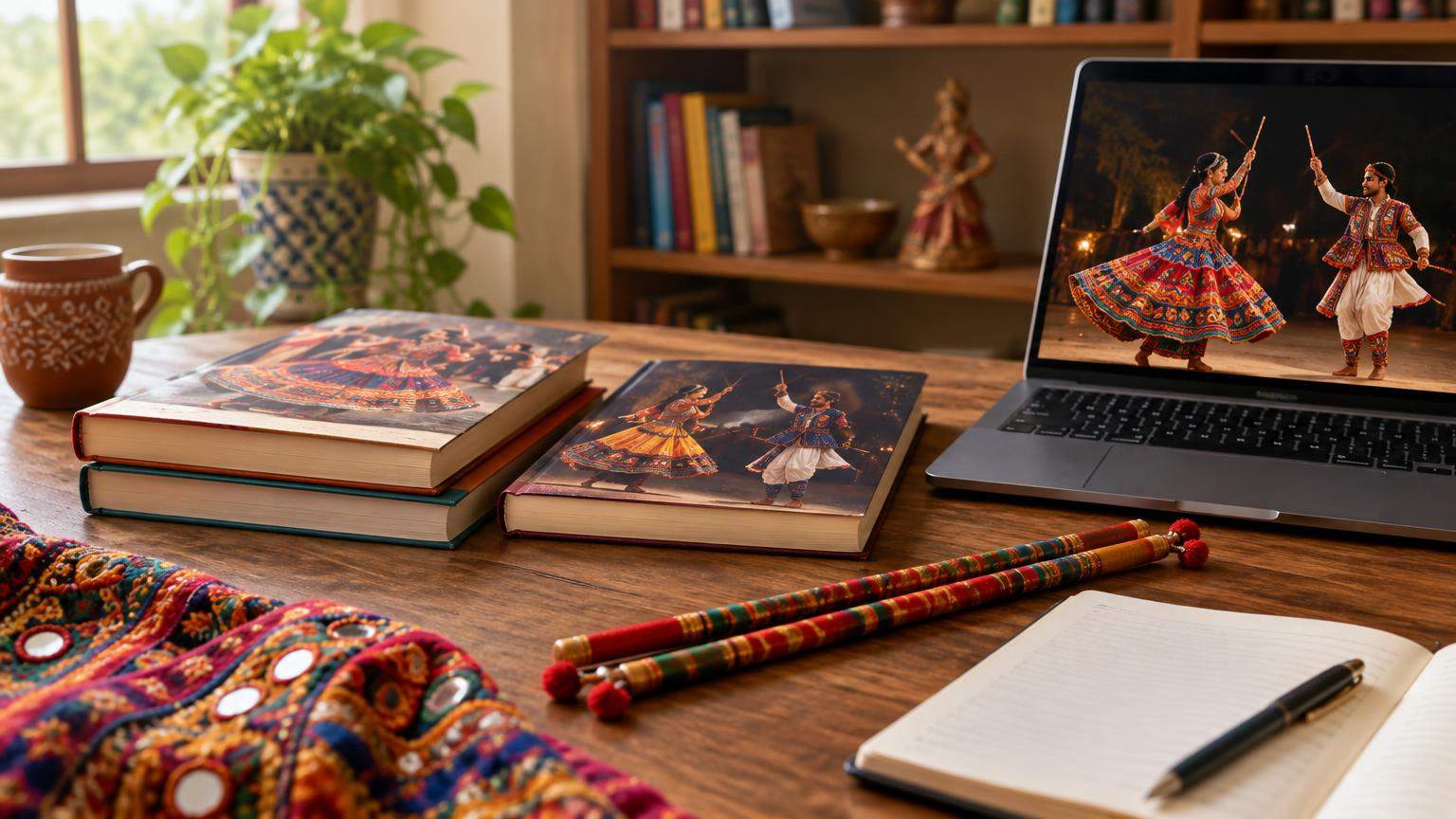
Dandiya Raas is another key Gujarati folk dance, characterised very clearly by the use of decorated wooden sticks called dandiyas. [1][3][9]
Cultural explainers describe it as energetic, rhythmic and playful—a performance that can evoke either the martial power of the goddess or the playful raas of Krishna, depending on regional storytelling. [3][9]
Stories and symbolism
Different sources emphasise different legends:
- Many festival and dance guides explain the sticks as symbolising the weapons of Goddess Durga in her battle with the buffalo demon Mahishasura; the striking of sticks is linked to the clash of arms. [3][9]
- Other accounts highlight connections to Krishna’s raas leela with the gopis, especially where the word “raas” is foregrounded; over time, these narrative strands have overlapped. [3][9]
Because written historical sources are limited, it is more accurate to treat these as widely told interpretations rather than one single proven origin story.
Formations and basic technique
Descriptions from folk‑dance teaching handouts and encyclopaedia entries agree on several core features of Dandiya Raas: [3][6][9]
- Props: Each dancer usually holds a stick in each hand, sometimes more elaborately decorated for performance.
- Partner work: Dancers commonly form pairs within a larger formation, striking their sticks against their partner’s in a set pattern.
- Formations: Double circles (one moving clockwise, one anti‑clockwise) or two long facing lines are frequent teaching formats. [6]
- Steps and strikes: Simple teaching patterns include a sequence of strikes (for example, right‑to‑right, left‑to‑left, overhead) combined with walking or hopping steps, then changing partners as the circle moves. [6]
Compared with Garba, the upper body is more engaged in Dandiya Raas because of the constant stick work. The tempo is often faster, which adds to the sense of excitement. [3][9]
Music and mood
Dandiya music overlaps with Garba in using Gujarati devotional and folk songs during Navratri, but performance notes and cultural guides describe it as more strongly driven by percussive beats suitable for stick striking. [3][8]
Modern Dandiya events—especially “dandiya nights” in cities—often rely on loud, uptempo tracks that keep energy high as dancers change partners and patterns rapidly. The social aspect—meeting friends, playful interaction—can feel more prominent here than in the more inwardly devotional early‑evening Garba, although in practice people may experience both as forms of worship and joy.
Garba vs Dandiya: side‑by‑side comparison
The table below summarises the most documented differences between Garba and Dandiya Raas. Because regional practice varies, think of these as typical tendencies rather than rigid rules.
| Aspect | Garba | Dandiya Raas |
|---|---|---|
| Cultural roots | Gujarati folk dance and ritual around a lamp or image of the goddess; now UNESCO‑listed intangible cultural heritage. [1][2][7] | Gujarati stick dance with associations to Durga’s battle with Mahishasura and/or Krishna’s raas leela. [3][9] |
| Main props | Typically no sticks; hands are free for claps and gestures, sometimes holding an aarti plate or scarf in specific rituals. [2][4] | Decorated wooden sticks (dandiyas) are central; dancers strike sticks with partners and sometimes with their own. [3][9] |
| Typical formations | Single or multiple concentric circles around a central lamp or deity. [2] | Double circles or facing lines of partners within a larger group. [3][6][9] |
| Movement quality | Flowing, circular walking or gliding steps with claps, arm sweeps and spins; often described as graceful and continuous. [2][5] | Energetic steps or hops with frequent stick strikes and partner changes; more overtly percussive and athletic. [3][6][9] |
| Music and tempo | Devotional songs to the goddess with lilting rhythms that support circular motion; tempo can build over the night. [4][8] | Music with a strong beat suited to stick striking; generally faster, especially at modern “dandiya nights”. [3][8] |
| Navratri timing | Often associated with the more explicitly devotional part of the evening, sometimes before or around aarti. [8][10] | Frequently performed as a celebratory segment during or after the main rituals, though actual sequencing varies. [3][10] |
| Clothing | Festive Gujarati attire such as chaniya choli and kediyu; similar to Dandiya. [1][3] | Very similar festive Gujarati attire; no strict costume difference from Garba. [1][3] |
A key point for any garba vs dandiya comparison is that organisers and communities often blur the lines. You may see Garba‑style steps performed to Dandiya‑style music, or sticks brought into otherwise Garba‑like routines, especially in choreographed shows. Traditional descriptions, however, maintain clear distinctions around props, formations and core movement ideas. [2][3][5]
If you’re new to Garba and want to practise the basic movements before attending a Navratri celebration, explore our step-by-step guide to Garba dance steps for beginners. It covers beginner-friendly footwork, rhythm, coordination and common practice mistakes.
How the beginner experience differs
From a learner’s point of view, Garba and Dandiya Raas feel different in the body and have different early challenges.
Learning Garba as a beginner
Sources that document Gujarati folk dances emphasise that Garba adapts well to different skill levels. [2][5]
For a new dancer, typical experiences include:
- Entry steps: Most people begin with a basic 2‑step or 4‑step pattern repeated in the circle. Once this feels comfortable, they add claps, arm movements and occasional turns. [5]
- Rhythm and stamina: The main challenge is maintaining steady rhythm over many repetitions and keeping energy up as the music gradually increases in speed.
- Spatial awareness: Because everyone is travelling in a circle, it is important to match the pace of people in front of and behind you to avoid bunching or gaps.
For shy dancers, Garba can feel relatively low‑pressure because you are almost always facing sideways or towards the centre rather than dancing directly “at” a partner. At the same time, the shared circle creates a strong feeling of community, which UNESCO singles out as part of Garba’s social value. [2]
Learning Dandiya Raas as a beginner
Teaching handouts and cultural notes present Dandiya Raas as suitable even for schoolchildren, but they also show that coordination requirements are higher than in very simple Garba. [3][6]
A new Dandiya learner typically has to manage:
- Two layers of timing: Footwork (walking or hopping) in time with the beat and stick strikes in time with the partner.
- Partner changes: Many patterns end with a turn and move to a new partner; losing your place can disrupt the line or circle.
- Safety: Beginners must learn to control the strength and direction of their stick strikes to avoid hitting hands or faces.
On the positive side, the clear structure of count‑based stick patterns can make Dandiya feel like a fun game once the basic sequence is memorised. Many learners enjoy the rapid social interaction of constantly meeting new partners within the circle. [6]
Movement, music and tradition: overlaps and variations
Any honest garba vs dandiya guide must stress that practice on the ground does not always match textbook descriptions. Gujarati folk‑culture studies remark on how Garba and Raas traditions have evolved over time and adapt to new contexts. [5]
Regional styles and hybrids
Within Gujarat itself, researchers and cultural practitioners observe multiple local styles of both Garba and Raas:
- Some communities favour slower, more devotional Garba with relatively simple steps, while others develop highly athletic, fast sequences for competitions. [5]
- Raas can appear as Dandiya Raas (short sticks), but also in variants that use other props or emphasise hand movements differently. [5][9]
As people move between regions and into cities, these styles influence each other. Event organisers might structure an evening as alternating “Garba” and “Raas” rounds, but on the floor many dancers mix steps they know from different teachers and films.
Urban and non‑Gujarati contexts
In cities across India, Navratri has increasingly become a cross‑regional festival, and cultural explainers note that Garba and Dandiya are now practised well beyond Gujarati communities. [1][8]
That expansion brings variety:
- Playlists may combine traditional Gujarati bhajans with Hindi film songs that only loosely follow Garba or Dandiya rhythm patterns.
- Choreographers sometimes stage group performances labelled “Garba” that incorporate contemporary dance or classical Indian dance vocabulary.
- Some events use the combined phrase “Garba‑Dandiya night” without strictly separating the two segments.
For participants, the safest approach is to treat Garba and Dandiya as reference points rather than strict categories, and to follow the cues of local organisers or instructors.
Beliefs and devotional focus
Both Garba and Dandiya Raas are strongly associated with Navratri, a festival centred on the worship of the goddess over nine nights and ten days. [8]
Navratri explanations note that different nights emphasise different forms of the goddess, and that dances like Garba and Raas serve both as offerings and as ways for the community to come together. [8]
In many Gujarati families, even when events feel like big social gatherings, people still begin with prayers or aarti, and some maintain a distinction between more inwardly devotional Garba around the lamp and more exuberant Dandiya Raas later in the evening. [8][10] However, this sequence is not universal and should be understood as common practice rather than a rigid ritual rule.
Choosing what to learn: a practical decision guide
If you are planning for Navratri and wondering whether to focus on Garba or Dandiya Raas first, you can use a few simple questions to guide your choice.
1. What kind of event are you attending?
- Traditional community Garba or temple‑linked Navratri: You will almost certainly encounter Garba, and there may or may not be a separate Dandiya segment. Learning basic Garba steps should be your priority. [2][8]
- Commercial “Dandiya Night” or club event: Promotional material often emphasises sticks and high‑energy music; here, Dandiya basics will be very useful, even if some Garba segments are included. [3][9]
- Mixed “Garba‑Dandiya” gatherings: These are common in housing societies, colleges and offices. If time permits, learning a simple Garba basic plus one Dandiya partner pattern will cover most situations.
2. How comfortable are you with partner interaction?
- If you prefer to move in a group without much one‑to‑one focus, Garba may feel more comfortable because you rarely have to maintain eye contact or coordination with a specific partner for long.
- If you enjoy quick exchanges and do not mind making mistakes while laughing with others, Dandiya Raas offers more direct interaction and playfulness. [3][6]
3. What kind of physical movement do you enjoy?
- For flowing, continuous motion: Choose Garba. It emphasises circles, sways and spins, building a sense of rhythm gradually. [2][5]
- For rhythmic, percussive action: Choose Dandiya Raas. Striking the sticks in time with music and partners is surprisingly satisfying once you get the hang of it. [3][6][9]
4. How much time do you have to prepare?
- With just an hour or two, most beginners can pick up a simple Garba basic plus a couple of easy variations well enough to blend into the circle. [5]
- Dandiya basics can also be learned quickly, but you need a bit of practice to become safe and confident with the sticks and partner turns. Starting even slightly earlier helps. [6]
In practice, many Navratri enthusiasts in India learn both forms over time. Starting with one does not lock you out of the other; instead, the rhythmic sense and spatial awareness you build in Garba can help with Dandiya, and vice versa.
Frequently Asked Questions
Is Garba always done without sticks and Dandiya always with sticks?
Traditional descriptions are clear that Garba is a hand‑and‑foot dance and Dandiya Raas is a stick dance. [2][3][9] In modern practice, however, choreographers sometimes experiment—using sticks in Garba‑like routines or creating fusion shows. So the presence of sticks is a strong indicator, but not the only thing to consider; formation, music and movement quality matter too.
Do Garba and Dandiya Raas use completely different music?
No. Both often use Gujarati songs associated with Navratri and devotion to the goddess. [1][8] The difference is more in how the music is arranged and felt: Garba sets frequently have a more lilting, circular rhythm, while Dandiya tracks emphasise strong beats for stick striking and partner changes. [3][8]
Are Garba and Dandiya Raas only Gujarati, or can anyone participate?
While both forms originated in Gujarat and are strongly identified with Gujarati culture, festival coverage and UNESCO’s recognition of Garba underline that people of many backgrounds now participate in them, in India and abroad. [1][2][8] At most public Navratri events, non‑Gujaratis are welcome as long as they respect local customs and follow organisers’ guidance.
Is there a right order: Garba first, then Dandiya?
Some educational resources explain that Garba is traditionally done before the aarti and Dandiya afterwards. [10] However, Navratri customs are diverse. In some places you may see multiple short Garba and Dandiya segments alternating through the evening, or only Garba, or only Dandiya. It is better to see “Garba first, Dandiya later” as a common pattern rather than a fixed rule everywhere.
Which dance is easier for absolute beginners?
This depends on your preferences, but many teachers find that a basic Garba step is slightly easier to pick up quickly because you do not have to manage sticks or close partner coordination. [5][6] Dandiya Raas may feel more challenging at first, but also more like a lively game once the pattern clicks.
Disclaimer
This article offers a general cultural comparison of Garba and Dandiya Raas based on reputable encyclopaedic, media and educational sources. [1][2][3][4][5][6][7][8][9][10] Actual practice varies widely between regions, communities and individual events. For precise information about rituals, dress codes or expectations at a specific Navratri celebration, please follow the guidance of local organisers, teachers or community elders.
Sources and Further Reading
Primary and supporting references. Verify time-sensitive information at the original publisher.
- Culture Of Gujarat — en.wikipedia.org
- Garba Gujarat Inscribed Unesco Representative List Intangible Cultural Heritage — www.unesco.org
- Dandiya Raas Dance In Gujarat India — www.danceus.org
- Garba Gujarat Navratri Crores History 10917065 — indianexpress.com
- AL Lok Sanskriti 1 — vyanjanasociety.com
- Sanna 2019 Handout Final — shirleylacroix.com
- List Of Indian Folk Dances — en.wikipedia.org
- Navaratri — en.wikipedia.org
- Dandiya Raas — en.wikipedia.org
- What Is The Difference Between Dandiya Raas And Garba Raas — www.4to40.com
Research date: October 18, 2026 (UTC). Links may change.